

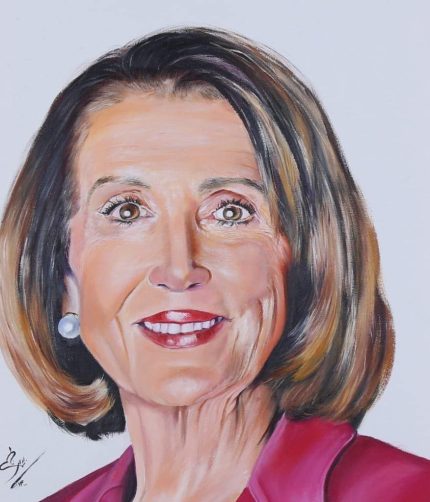
Jacinda Ardern
In Stock
Highlights:
CompareThe youngest female head of government in the world
Jacinda Kate Laurell Ardern (born 26 July 1980) is a New Zealand politician who has been the 40th prime minister of New Zealand and leader of the Labour Party since 2017.
Categories: A World Without Borders, Painting Collections
Related products
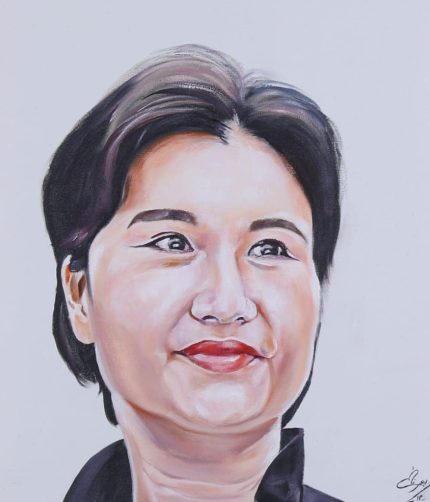
Zhou Qunfei
Rated 0 out of 5
(0)
Highlights:
She’s a Chinese entrepreneur (born 1970) who founded the major touchscreen maker Lens Technology. In 2018, she was named the world’s richest self-made woman, with a net worth of $9.8 billion. She has a net worth of $ 12.5 billion and is the China’s fifth richest woman.
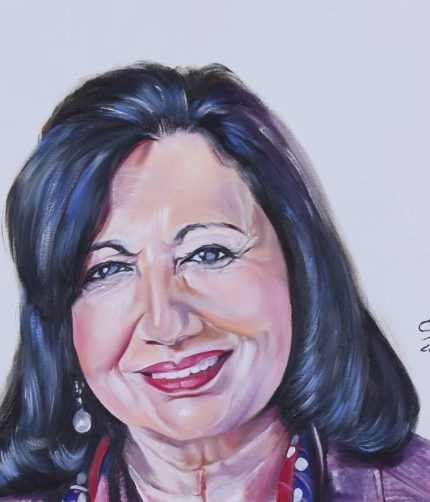
Mazumdar Shaw
Rated 0 out of 5
(0)
Highlights:
Mazumdar-Shaw dislikes the term ‘philanthropy”, believing that it often provides temporary fixes rather than addressing the root cause or the underlying situation. She prefers the term “compassionate capitalist”
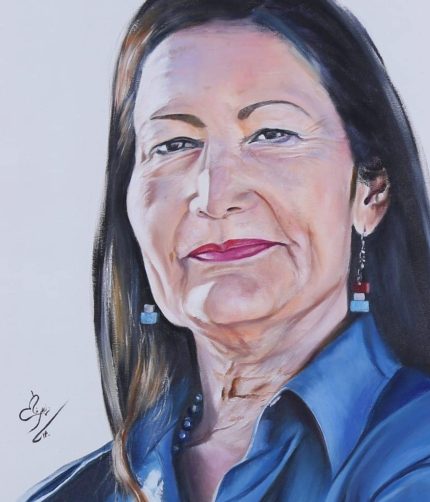
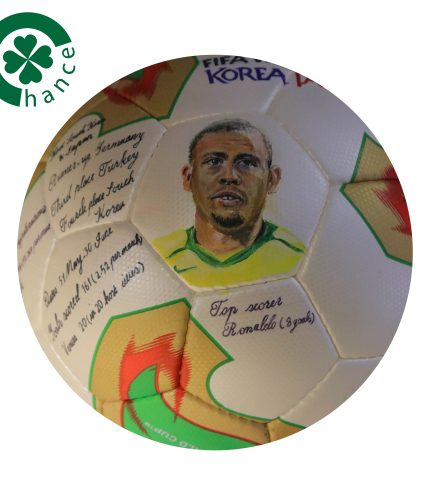
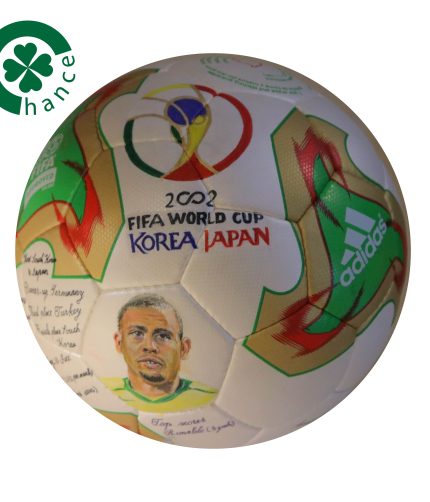
2002 World Cup Painted Ball
Rated 0 out of 5
(0)
Highlights:
Product Name : 2002 World Cup Painted Ball
Date of Registration : 02/01/2023
Category Art : Painting
Art Field : Visual Arts
Total Production : One Collection with Twenty Three Balls
Production Year : 2022
Art Style : Acrylic
Ball Name : Fevernova
Artist Name : Fatemeh Zarei
Size : 5
Weight (gr) : 389 – 398
Has a signature : Yes
Materials :
Adidas’s Fevernova soccer ball was the official ball of the Korea Japan, 2002 FIFA world cup. The adidas Fevernova was the first World Cup Match Ball since 1978 to break with the traditional Tango design introduced in 1978. It is three millimeters thick (11 layers). This includes a special foam layer with tiny gas filled balloons imbedded in a syntactic foam. The foam is based on an abrasion resistant polyurethane made by Bayer called Impranil® polyurethane. The outer cover of the ball consists of a combination of special synthetic polystyrenes (polyurethane) and natural rubber. Embedded within the layers are equal sized, highly elastic, exceptionally resistant gas-filled microcells. The inner lining consists of a tightly woven network of knitted, synthetic Raschel fabric. The spongy layer has high modulus of compression, with a good elastic memory. These layers give the Fevernova TM improved rebound characteristics, which convert foot strike into ball acceleration. The outer layer of the ball is made of a particularly so that the ball can withstand exceptionally tough treatment. All of this combines to give the ball greater durability. According to Adidas, the surface of the new ball converts applied energy evenly at every point. Theoretically, this gives a more calculable, flight path with advanced players. The Adidas Fevernova TM is made to meet the lower end of FIFA regulations governing circumference and the upper limit of weight , in which smaller and heavier sphere has a more accurate trajectory.
About Fevernova :
The ball Fevernova has been obtained as a result of three years of work to improve the previous Tricolore ball at the research center in south of Germany.
The new design is based on Asian culture and are not similar to its predecessors. This ball featured a refined syntactic foam layer, to give the ball superior performance characteristics, and a three-layer knitted chassis, allowing for a more precise and predictable flight path. For the World Cup matches has been presented more than 2,500 balls Fevernova, and later around the world has been sold about six million replicas.
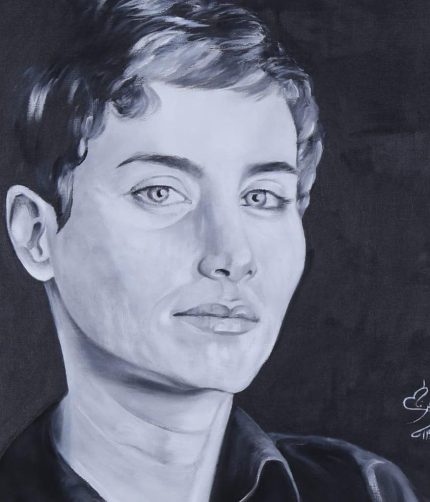
Maryam Mirzakhani
Rated 0 out of 5
(0)
Highlights:
Maryam Mirzakhani
(12 May 1977-14 July 2017) was an Iranian mathematician and a professor of mathematics at Stanford University. Her research topics included Teichmüller theory, hyperbolic geometry, ergodic theory, and symplectic geometry. In 2005, as a result of her research, she was honored in Popular Science’s fourth annual “Brilliant 10” in which she was acknowledged as one of the top 10 young minds who have pushed their fields in innovative directions.
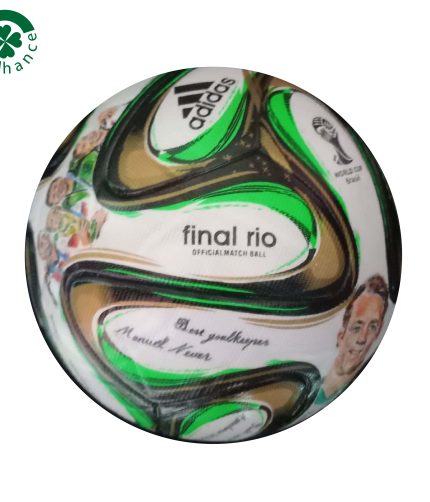
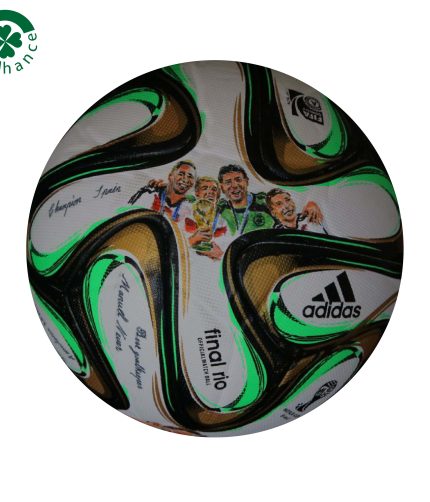
2014 World Cup Painted Ball
Rated 0 out of 5
(0)
Highlights:
Product Name : 2014 World Cup Painted Ball
Date of Registration : 02/01/2023
Category Art : Painting
Art Field : Visual Arts
Total Production : One Collection with Twenty Three Balls
Production Year : 2022
Art Style : Acrylic
Ball Name : Brazuca
Artist Name : Fatemeh Zarei
Size : 5
Weight (gr) : 425 – 432
Has a signature : Yes
Materials :
The Brazuca official match ball has only 6 flat parts, 12 seams and 8 joint points – but the seams do not go along the edges of the cube they go over a complex curve. This provide suitable aerodynamics and an unrivaled circular shape to the ball.
The Brazuca 2014 ball decorated with ribbons of three colors, which symbolizing the so-called bracelets desires in Brazil. According to legend, the bangle should be wrapped around the wrist and tie the knot three with making a wish on each of them. When the bracelet will tear himself fall from his hands, they believed that it’s made wishes should start to come true.
About Brazuca :
The name of the 2014 World Cup ball has been selected in an open vote, which was attended by more than 1 million of Brazilians. Has been proposed 3 names: Brazuca (77.5%), Carnavalesca (14.6%) and Bossa Nova (7.6%).
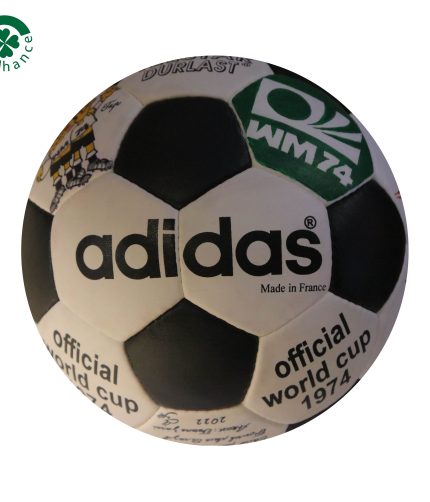
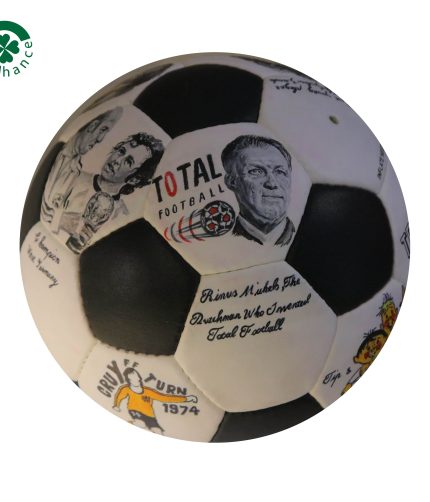
1974 World Cup Painted Ball
Rated 0 out of 5
(0)
Highlights:
Product Name : 1974 World Cup Painted Ball
Date of Registration : 02/01/2023
Category Art : Painting
Art Field : Visual Arts
Total Production : One Collection with Twenty Three Balls
Production Year : 2022
Art Style : Acrylic
Ball Name : Telstar Durlast
Artist Name : Fatemeh Zarei
Size : 5
Weight (gr) : 428 – 436
Has a signature : Yes
Materials :
It’s first Adidas ball which was using in a World Cup. It was made of leather and was shaped like a truncated icosahedron, composed of 12 black pentagons and 20 white hexagons. Name of the ball Telstar was formed from the respective titles of the American artificial satellite of Earth, put into orbit in 1962. Moreover, the ball has been nicknamed “Star of Television”, because design of the ball is compatible for black-and-white TV.
About Telstar Durlast :
The ball used for the 1970 and 1974 World Cup was the Telstar, design by Adidas. It was the first white football ever to be painted with black pentagons which became synonymous with football throughout the world. The distinct 32 white and black leather panels that comprised the Telstar made it the roundest ball of its time.
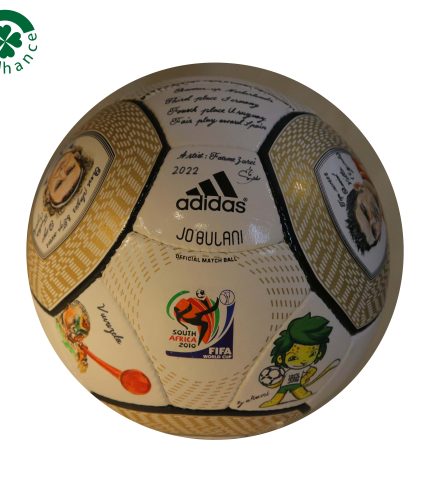
2010 World Cup Painted Ball
Rated 0 out of 5
(0)
Highlights:
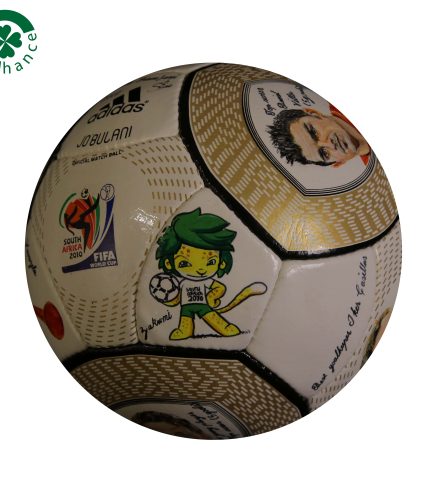
Product Name : 2010 World Cup Painted Ball
Date of Registration : 02/01/2023
Category Art : Painting
Art Field : Visual Arts
Total Production : One Collection with Twenty Three Balls
Production Year : 2022
Art Style : Acrylic
Ball Name : Jabulani
Artist Name : Fatemeh Zarei
Size : 5
Weight (gr) : 386 – 396
Has a signature : Yes
Materials :
The adidas Jabulani features 32 panels, each one representing a different African nation that will take part in this summer’s tournament. These nations are: Angola, Egypt, Ghana, Guinea, Ivory Coast, Kenya, Lesotho, Liberia, Madagascar, Malawi, Mozambique, Namibia, Nigeria, Rwanda, Senegal, Seychelles, Sierra Leone, Somalia, Sudan, Swaziland, Tanzania, Togo, Tunisia, Uganda, and Zimbabwe.
On top of having a beautiful design, the new Jabulani ball is technologically advanced, making it feel more like playing with a leather ball while providing consistent quality on all surfaces. It is also one of the most aerodynamic balls on the market today.
About Jabulani :
In language of the Zulu word Jabulani means “celebrate”. The World Cup 2010 ball is made in South African style. Jabulani comprises eight external structural panels interconnected by a heat seal technology, that increases Shot Accuracy.
2006 World Cup Painted Ball
Rated 0 out of 5
(0)
Highlights:
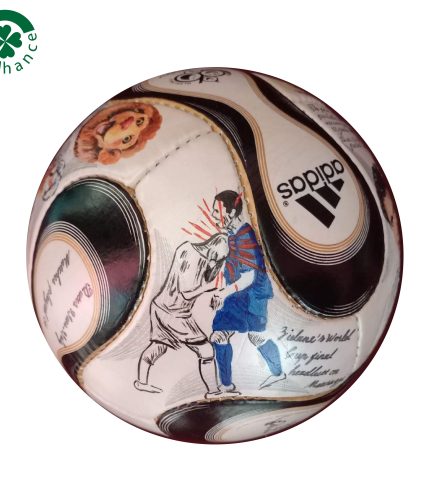
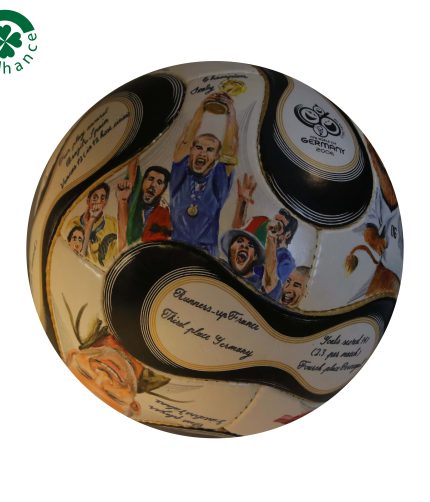
Product Name : 2006 World Cup Painted Ball
Date of Registration : 02/01/2023
Category Art : Painting
Art Field : Visual Arts
Total Production : One Collection with Twenty Three Balls
Production Year : 2022
Art Style : Acrylic
Ball Name : Teamgeist
Artist Name : Fatemeh Zarei
Size : 5
Weight (gr) : 420 – 430
Has a signature : Yes
Materials :
The ball was designed by the Adidas Innovation Team and the Molten Corporation and is made by Adidas, which has provided the balls used in all World Cup matches since the 1970 World Cup when the Telstar was introduced. The +Teamgeist ball differs from previous balls in having just 14 curved panels (making the ball topologically equivalent to a truncated octahedron), rather than the 32 that have been standard since 1970. Like the 32 panel Roteiro which preceded it, the +TeamGeist panels are bonded together, rather than stitched. It is claimed to be rounder and to perform more uniformly regardless of where it is hit, and being almost waterproof, it does not get heavier in wet weather.
About Teamgeist :
With the name of “Teamgeist” the creators of the ball wanted to remind that one of the most important components of success in World Cup it’s “team spirit”. Translated from the German word team means “command” and geist – “spirit”.
1986 World Cup Painted Ball
Rated 0 out of 5
(0)
Highlights:
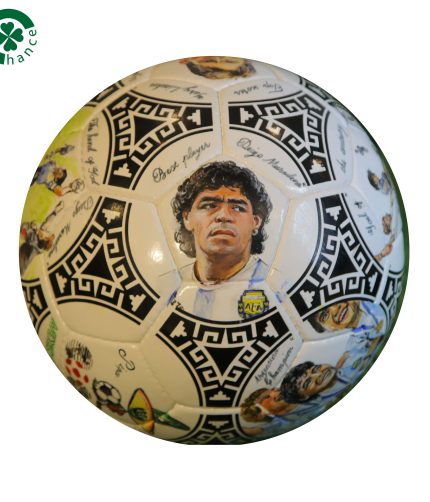
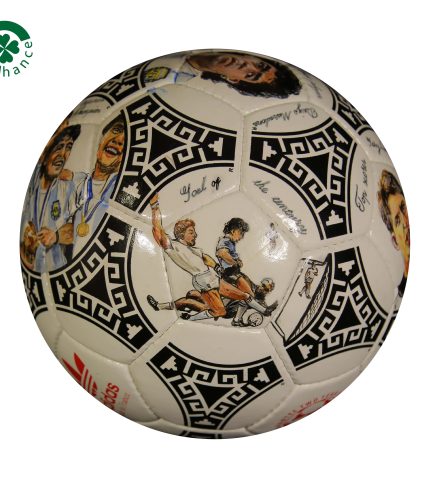
Product Name : 1986 World Cup Painted Ball
Date of Registration : 02/01/2023
Category Art : Painting
Art Field : Visual Arts
Total Production : One Collection with Twenty Three Balls
Production Year : 2022
Art Style : Acrylic
Ball Name : Azteca
Artist Name : Fatemeh Zarei
Size : 5
Weight (gr) : 380 – 410
Has a signature : Yes
Materials :
A completely new model was developed for the World Cup in Mexico. The Azteca Mexico was a hand-sewn ball, and for the first time, synthetic material, rather than leather was used to produce it. The ball consisted of an outer polyurethane wearing coat and three lower layers, which mutually complemented one another with their different “Adicron” structures. These were intended to ensure the ball’s resistance, ability to retain its shape and its waterproof properties. With its never-before-achieved performance on hard ground, at high altitude, and in wet conditions, Azteca represented a massive leap forward for the game. Its elaborately decorated design was inspired by the hosting nation’s native Aztec architecture and murals.
About Questra :
Azteca ball – first ball which has been made of fully synthetic material. Triad used in the design of the ball, where were painted like Aztecs frescoes. The Adidas Azteca ball was quite an elegant ball with revolutionary design but even though it was still composed by 32 hand sewn panels.
1966 World Cup Painted Ball
Rated 0 out of 5
(0)
Highlights:
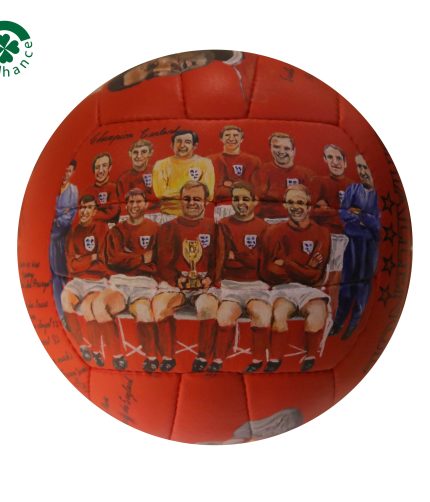
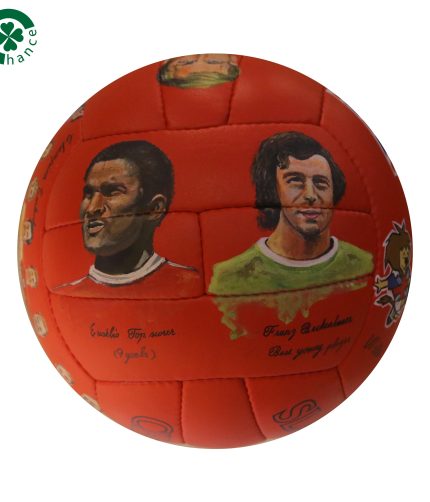
Product Name : 1966 World Cup Painted Ball
Date of Registration : 02/01/2023
Category Art : Painting
Art Field : Visual Arts
Total Production : One Collection with Twenty Three Balls
Production Year : 2022
Art Style : Acrylic
Ball Name : Slazenger 25 Challenge
Artist Name : Fatemeh Zarei
Size : 5
Weight (gr) : 370 – 382
Has a signature : Yes
Materials :
The Slazenger Challenge was made of high quality leather and entirely hand sewn. It was composed of 25 rectangular panels, joined together in a way that was very similar to the 1958 ball and which differed only in the panel which contained the valve. In the Slazenger
ball the valve was in the centre of a small panel between two other, even shorter panels.
The remaining panels were the same as the 1958 ball and the inflating system was the latest type valve – latex rubber. This ball provided excellent sphericity, and its composition was adopted over the years by other brands. The balls of the 1966 World Cup were
provided in three different colours: white, yellow, and orange. Although the most widely used model was the white one, in the memory of football fans the orange ball of the historic final of Wembley remains the strongest.
About Slazenger 25 Challenge :
The match ball used during the 1966 World Cup final, as England beat West Germany 4-2. Geoff Hurst famously scored a hat trick for England, but the ball was claimed by Helmut Haller and only returned to England in 1996. This object is displayed courtesy of Eurostar, Mirror Group and Virgin
1954 World Cup Painted Ball
Rated 0 out of 5
(0)
Highlights:
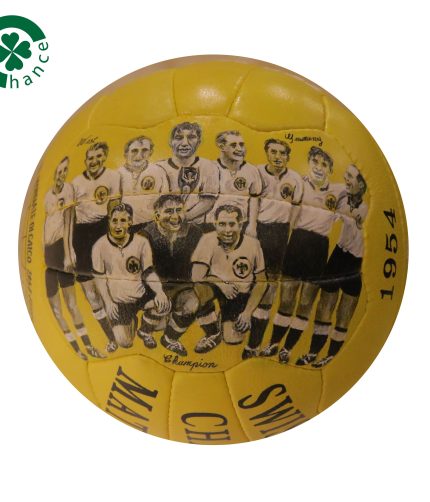
Product Name : 1954 World Cup Painted Ball
Date of Registration : 02/01/2023
Category Art : Painting
Art Field : Visual Arts
Total Production : One Collection with Twenty Three Balls
Production Year : 2022
Art Style : Acrylic
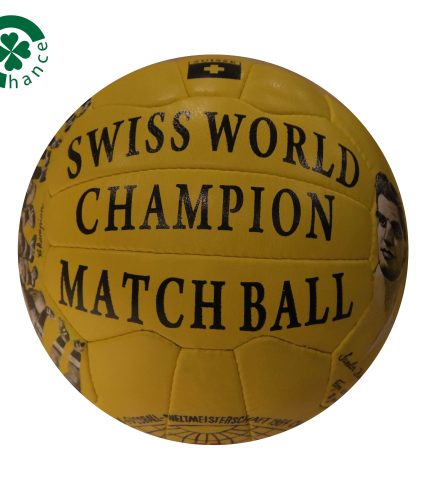
Ball Name : Swiss World Champion Match Ball
Artist Name : Fatemeh Zarei
Size : 5
Weight (gr) : 380 – 392
Has a signature : Yes
Materials :
The official match ball of the 1954 FIFA World Cup was composed of 18 panels with zigzag edges, perfectly interlocked to each other. (The same panel structure can be seen on many Mitre balls even today.) The ball was completely hand sewn and no longer had laces -just like its predecessor, the Superball from the 1950 World Cup. The colour of the ball was not dark brown any more, rather an attractive yellowish or hell orange. This made the ball more visible during rainy matches where the pitch contained mud. We can see lots of photographs in different newspapers and magazines from 1954 where the players are portrayed with the Swiss World Champion balls as this ball became by far the best selling World Cup ball compared to its predecessors.
About Swiss World Champion Match Ball :
this ball comes from the pre-adidas historical match ball set, it is the exact reproduction of the original Swiss World Champion balls as used at the 1954 World Cup in Switzerland.

Reviews
There are no reviews yet.