
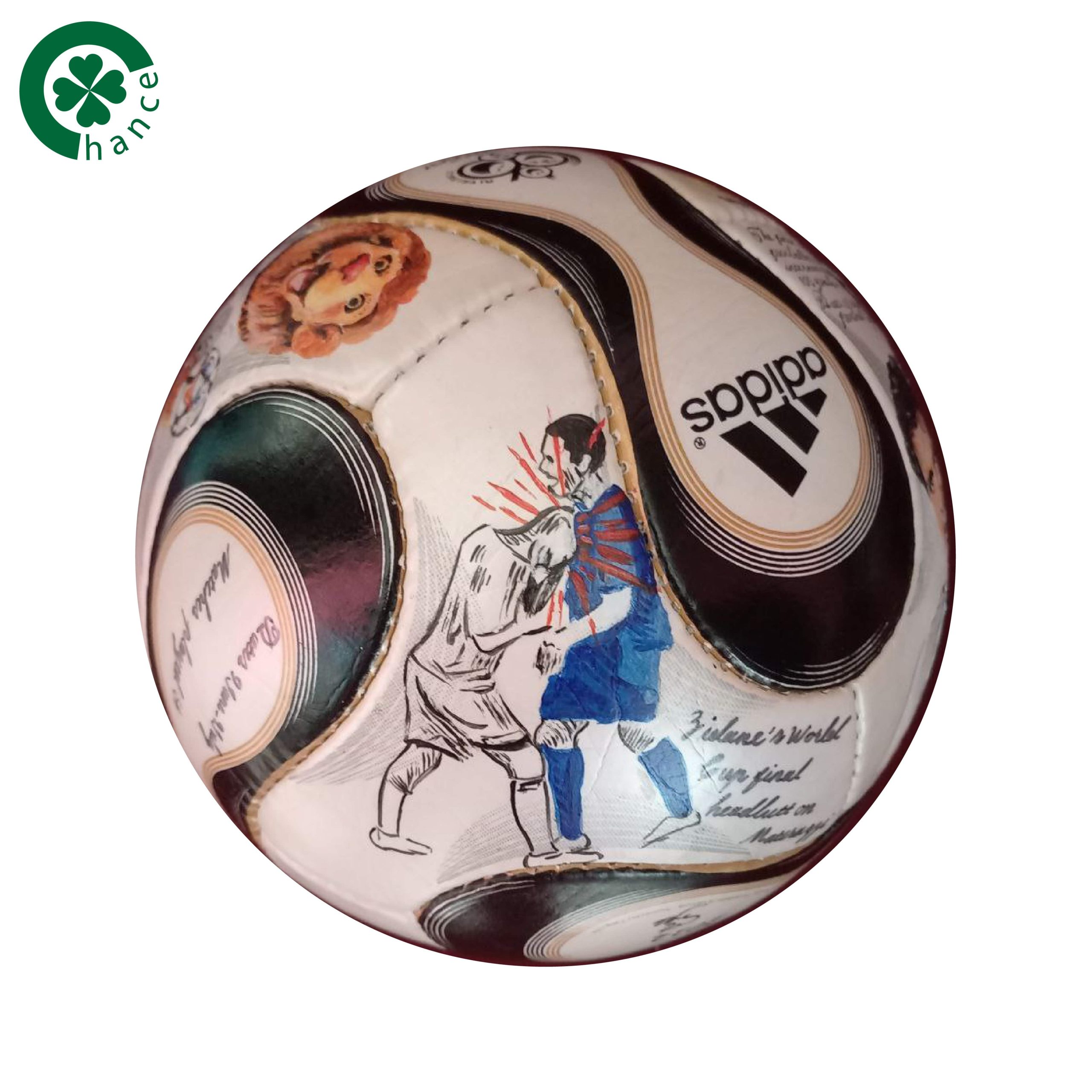

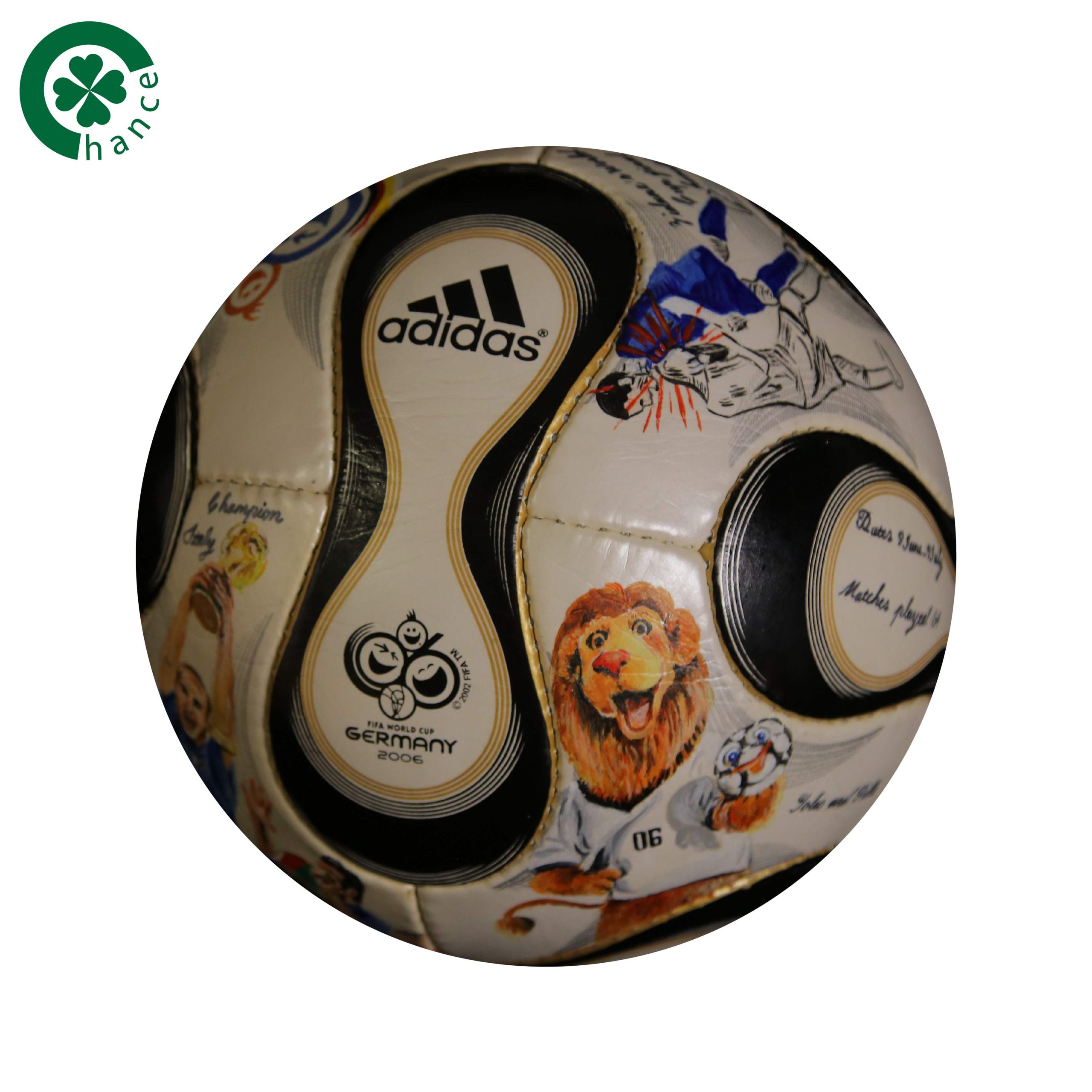
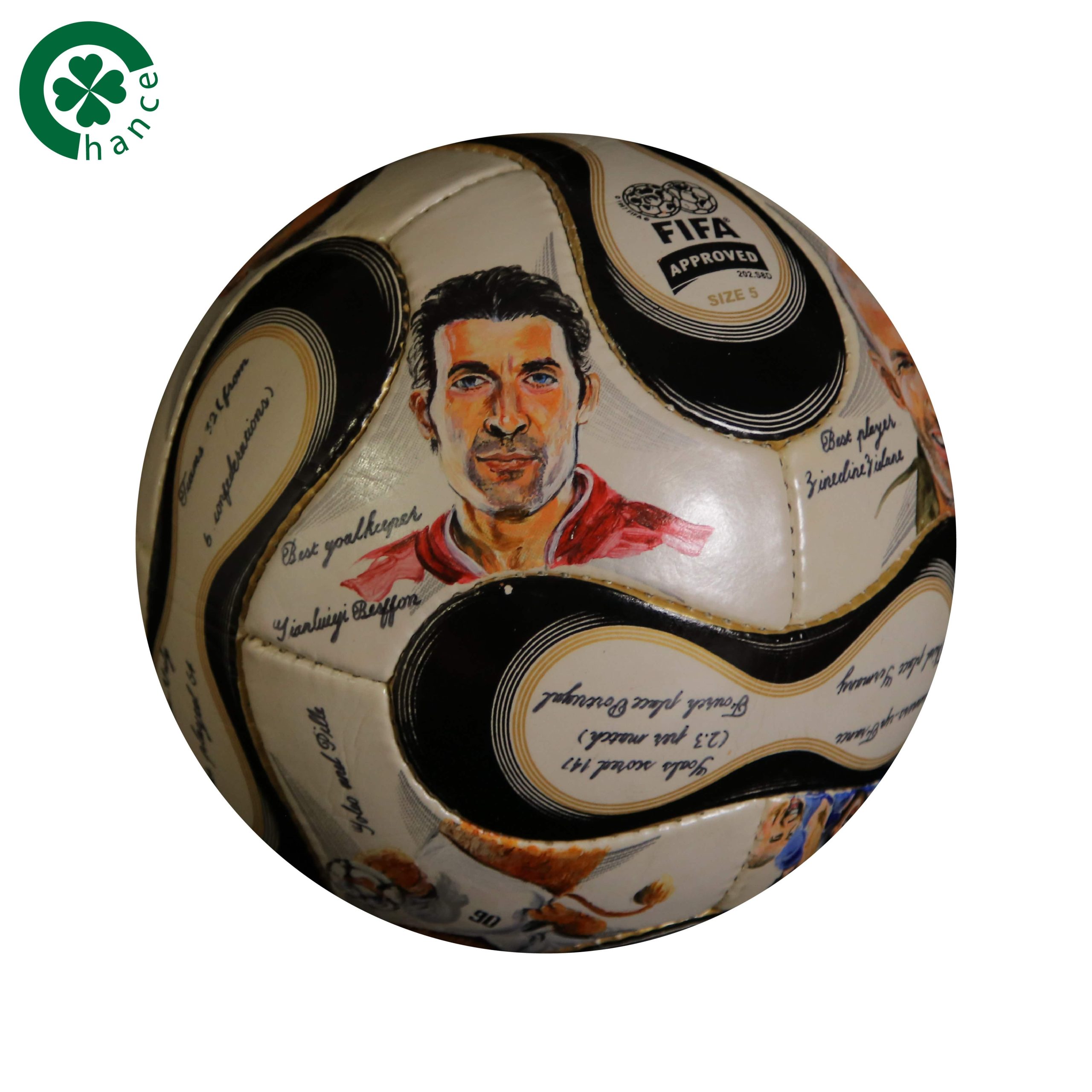
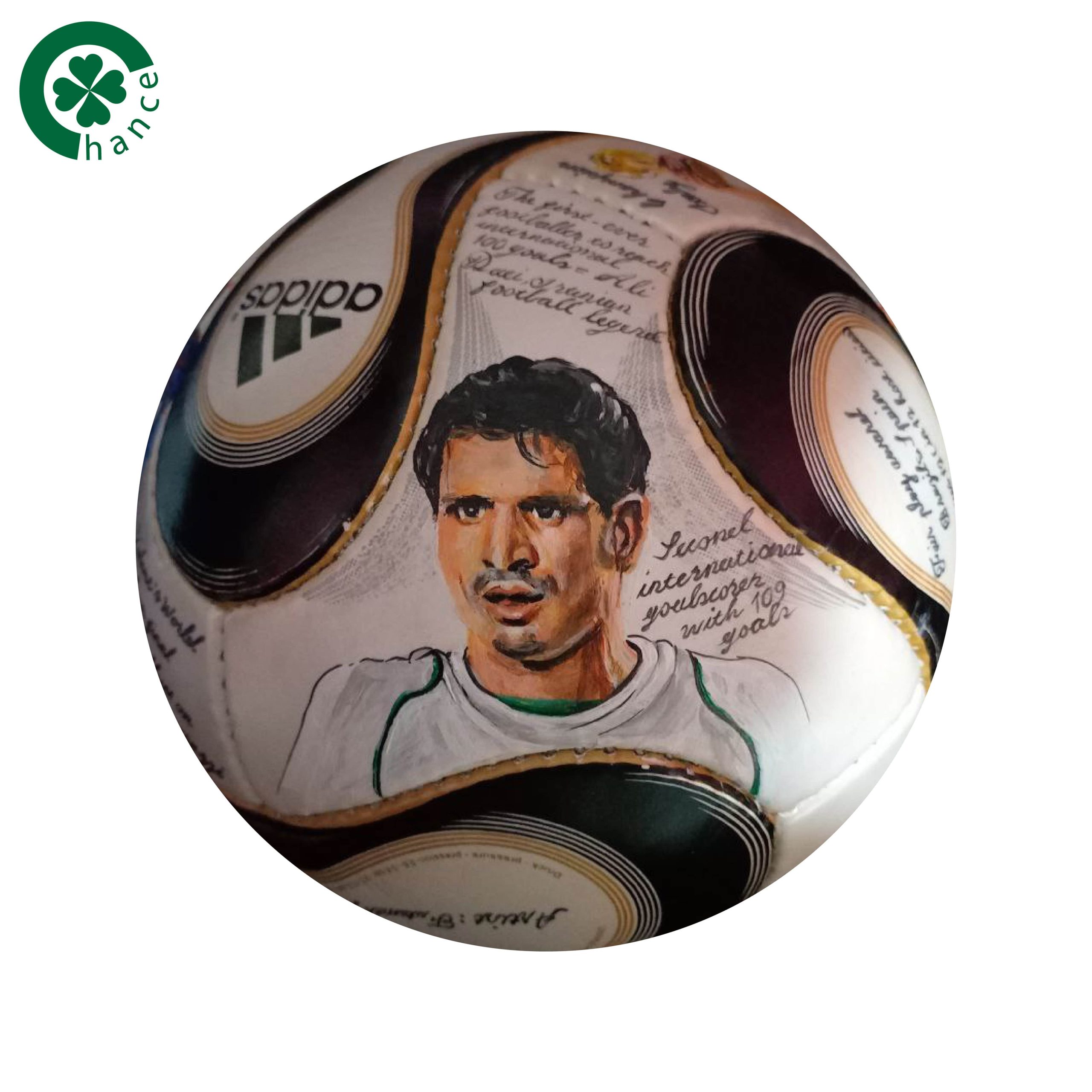

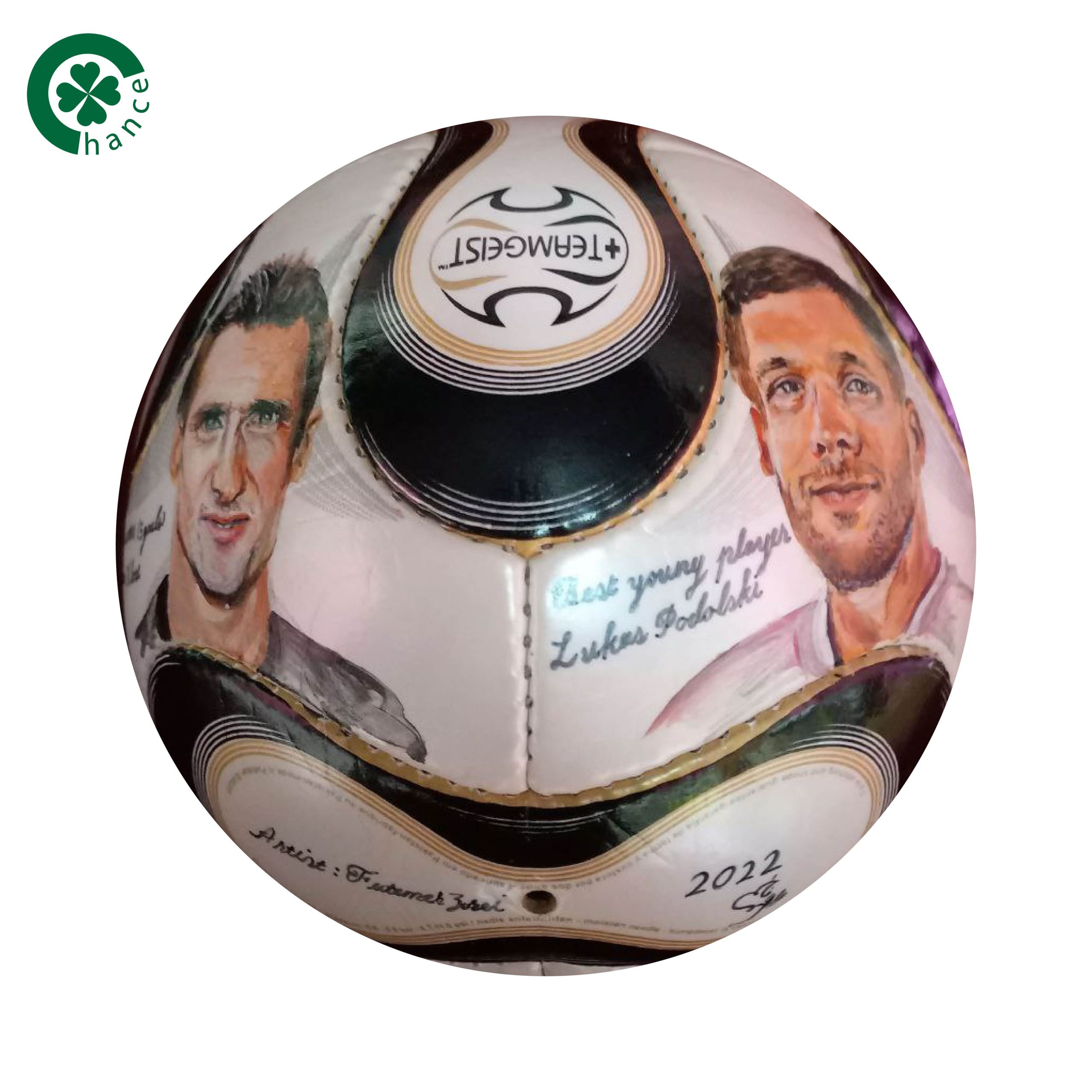
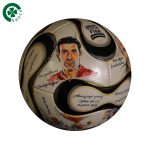
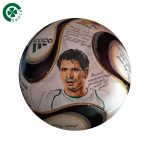
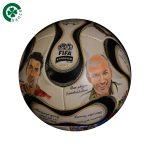
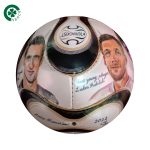
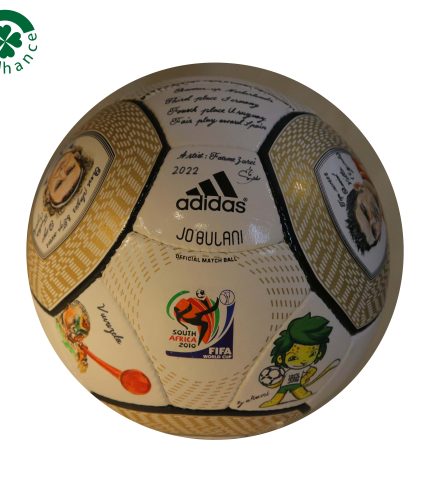
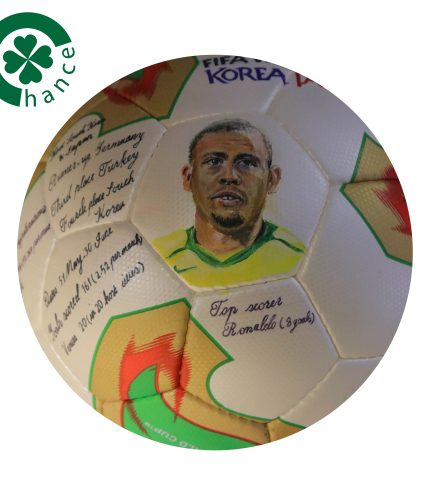
2006 World Cup Painted Ball
In Stock
Highlights:
CompareProduct Name : 2006 World Cup Painted Ball
Date of Registration : 02/01/2023
Category Art : Painting
Art Field : Visual Arts
Total Production : One Collection with Twenty Three Balls
Production Year : 2022
Art Style : Acrylic
Ball Name : Teamgeist
Artist Name : Fatemeh Zarei
Size : 5
Weight (gr) : 420 – 430
Has a signature : Yes
Materials :
The ball was designed by the Adidas Innovation Team and the Molten Corporation and is made by Adidas, which has provided the balls used in all World Cup matches since the 1970 World Cup when the Telstar was introduced. The +Teamgeist ball differs from previous balls in having just 14 curved panels (making the ball topologically equivalent to a truncated octahedron), rather than the 32 that have been standard since 1970. Like the 32 panel Roteiro which preceded it, the +TeamGeist panels are bonded together, rather than stitched. It is claimed to be rounder and to perform more uniformly regardless of where it is hit, and being almost waterproof, it does not get heavier in wet weather.
About Teamgeist :
With the name of “Teamgeist” the creators of the ball wanted to remind that one of the most important components of success in World Cup it’s “team spirit”. Translated from the German word team means “command” and geist – “spirit”.
Categories: Balls Collections, Painting Collections
Related products
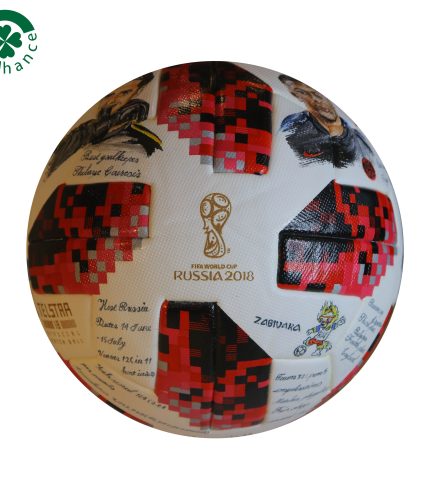
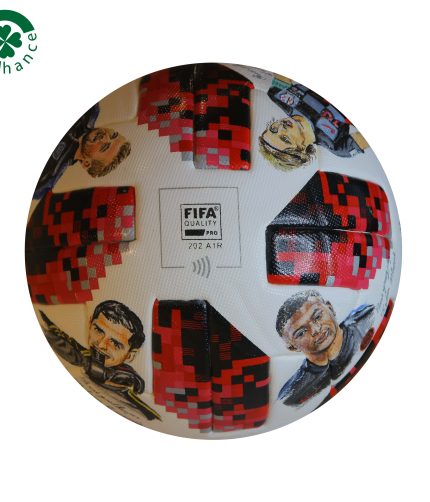
2018 World Cup Painted Ball
Rated 0 out of 5
(0)
Highlights:
Product Name : 2018 World Cup Painted Ball
Date of Registration : 02/01/2023
Category Art : Painting
Art Field : Visual Arts
Total Production : One Collection with Twenty Three Balls
Production Year : 2022
Art Style : Acrylic
Ball Name : Adidas Telstar 18
Artist Name : Fatemeh Zarei
Size : 5
Weight (gr) : 430 – 440
Has a signature : Yes
Materials :
Telstar 18 consists of 6 panels of Impranil®, a 65% recyclable, waterborne polyurethane (without co-solvents), glued with Dispercoll®, a waterborne environment friendly adhesive; the innermost layer of the ball skin is an adhesion coating that connects the textile substrate to the layers above. On top of this is a polyurethane foam layer, roughly one millimeter thick. Two compact layers of polyurethane provide the ball with very high elasticity, resistance to abrasion, and return to its original shape immediately after the kick (tests ensure that the ball would retain its shape even if fired at a steel wall 2,000 times at 50 km per hour). The technology and the materials used were studied to make the flight paths of the ball more Predictable, even if the subtle deformity created when it is kicked Is of course an unpredictable factor.
Telstar 18 contains also a microchip, which connects to your Smartphone and allows you to get information about the World Cup and matches.
About Telstar 18 :
Telstar 2018 is the name of the ball designed by Adidas specifically For the FIFA World Cup Russia 2018, a redesign of the first ball Manufactured by Adidas for the 1970 FIFA World Cup, when it was Held in Mexico.
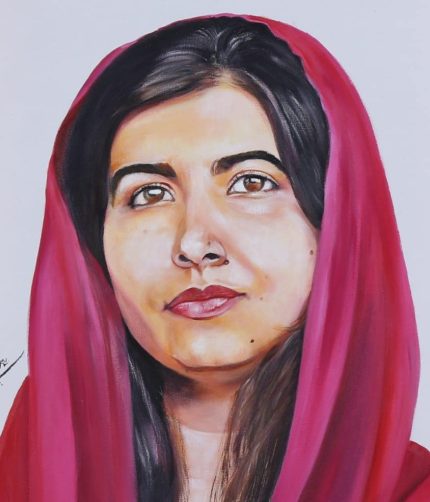
Malala Yousafzai
Rated 0 out of 5
(0)
Highlights:
(born 12 July 1997), she’s a Pakistani activist for female education and a Nobel Peace Prize laureate. At age 17, She is also the world’s youngest Nobel Prize laureate, and second Pakistani. She is known for human rights advocacy, especially the education of women and children.
1994 World Cup Painted Ball
Rated 0 out of 5
(0)
Highlights:
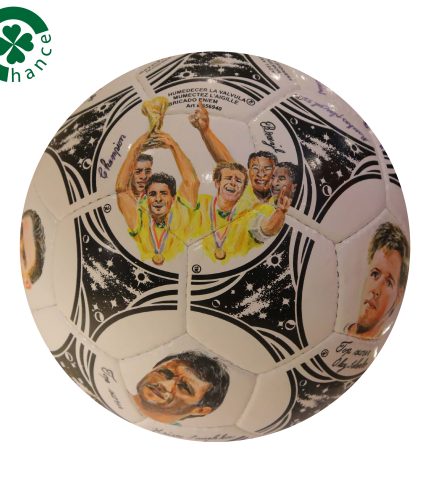
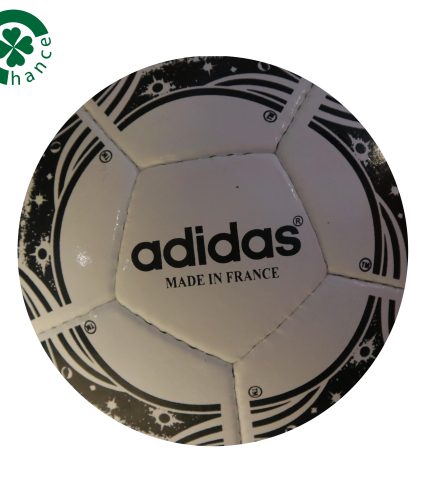
Product Name : 1994 World Cup Painted Ball
Date of Registration : 02/01/2023
Category Art : Painting
Art Field : Visual Arts
Total Production : One Collection with Twenty Three Balls
Production Year : 2022
Art Style : Acrylic
Ball Name : Questra
Artist Name : Fatemeh Zarei
Size : 5
Weight (gr) : 388 – 398
Has a signature : Yes
Materials :
At the 1990 World Cup in Italy, a negative World Cup record was set in terms of goals (2.21 goals/match), so many blamed the ball Before the next World Cup, FIFA asked adidas to develop a ball that could score more goals. The 1994 World Cup was brought to the USA in part to promote soccer, but if viewers don’t see enough goals, they tune out of the games on TV and think soccer is a boring
sport. The changes to the ball were successful, as the American World Cup had a higher goal average (2.7 goals/match), which they have not been able to surpass in any World Cup since then.
And what were the changes on the ball? Well, the Questra was lighter and more controllable than its predecessor, which favored more skilled players. Five different materials were used during development, and its most significant innovation was the flexible but resistant outer polyurethane layer, which softened the force of impacts thanks to foaming, and it was also beneficial for the headers.
This is due to the fact that the ball was developed at adidas’ ball production center in France and tested by French, German and American professional, amateur and youth teams.
About Questra :
Name of the Questra ball comes from ancient world for the pursuit to the stars (the quest for the stars). Authors aimed to create a more responsive and light ball, what they got fully. By manufacturing the new ball from five different materials and enveloping it in polystyrene foam, Adidas made the Questra more waterproof and allowed for greater acceleration when kicked. Triads which used in the design of Adidas Questra, display the outlines of stars.
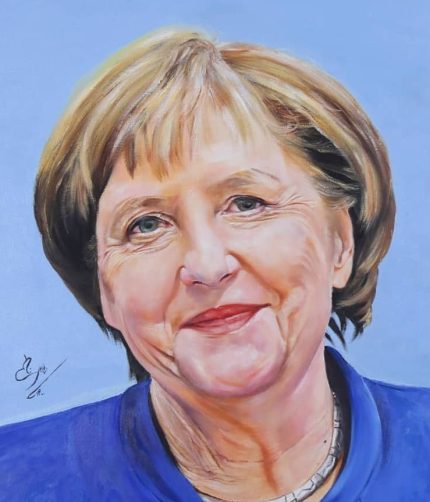
Angela Merkel
Rated 0 out of 5
(0)
Highlights:
Angela Merkel Chancellor of Germany
The Most Influential Political woman in art
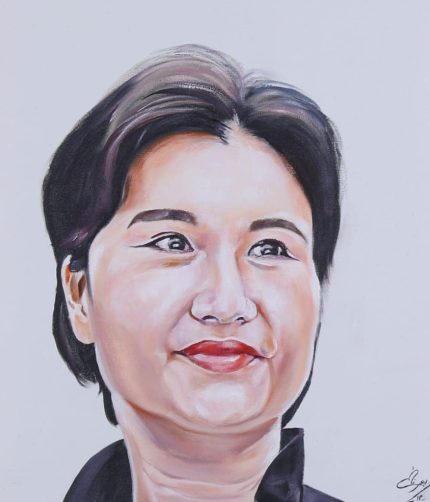
Zhou Qunfei
Rated 0 out of 5
(0)
Highlights:
She’s a Chinese entrepreneur (born 1970) who founded the major touchscreen maker Lens Technology. In 2018, she was named the world’s richest self-made woman, with a net worth of $9.8 billion. She has a net worth of $ 12.5 billion and is the China’s fifth richest woman.
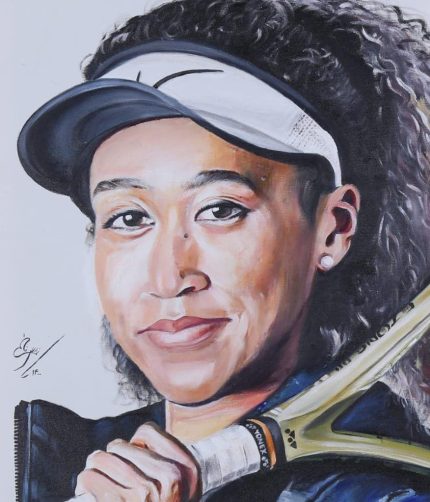
Naomi Osaka
Rated 0 out of 5
(0)
Highlights:
The highest paid female athlete in the world
Naomi Osaka (born October 16, 1997) is a Japanese professional tennis player. She has been ranked No. 1 by the Women’s Tennis Association (WTA) and is the first Asian player to hold the top ranking in singles as well the first player from Japan – man or woman – to reach No.1. She is a four-time Grand Slam singles champion.
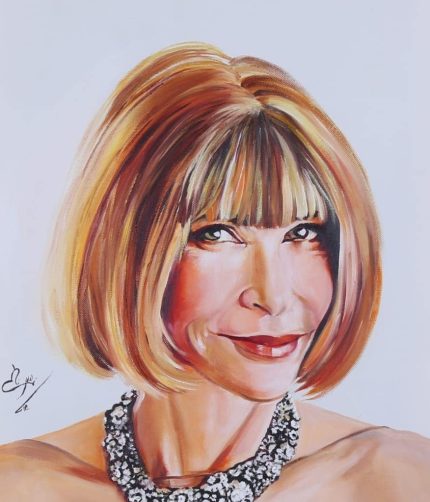
Anna Wintour
Rated 0 out of 5
(0)
Highlights:
Queen of the fashion world
Dame Anna Wintour DBE (born 3 November 1949) is a British-American journalist, who has served as Editor-in-Chief of Vogue since 1988 and Global Chief Content Officer for Condé Nast since 2020;
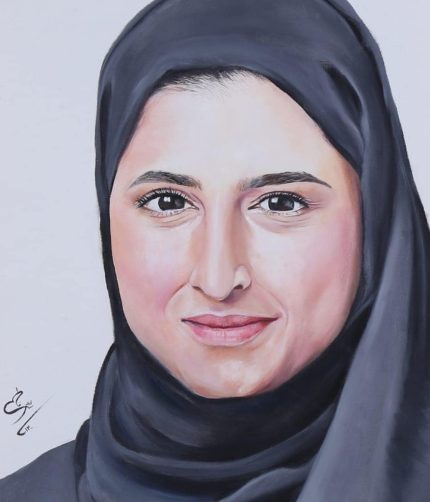
Sarah Al Amiri
Rated 0 out of 5
(0)
Highlights:
Sarah bint Yousef Al Amiri (born 1987) is the Minister of State for Advanced Technology within the Ministry of Industry and Advanced Technology in the government of the United Arab Emirates, chair of the UAE Space Agency and the UAE Council of Scientists, and Deputy Project Manager of the Emirates Mars Mission.

Maryam Mirzakhani
Rated 0 out of 5
(0)
Highlights:
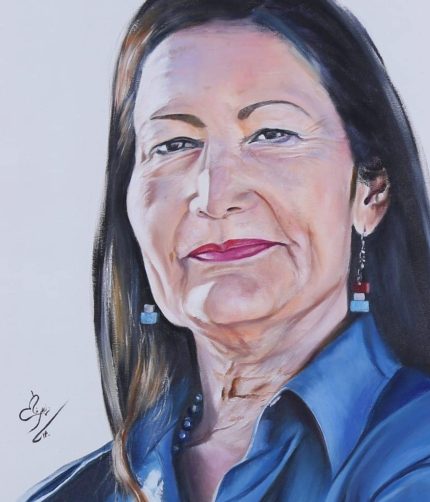
Maryam Mirzakhani
(12 May 1977-14 July 2017) was an Iranian mathematician and a professor of mathematics at Stanford University. Her research topics included Teichmüller theory, hyperbolic geometry, ergodic theory, and symplectic geometry. In 2005, as a result of her research, she was honored in Popular Science’s fourth annual “Brilliant 10” in which she was acknowledged as one of the top 10 young minds who have pushed their fields in innovative directions.
Ngozi Okonjo Lweala
Rated 0 out of 5
(0)
Highlights:
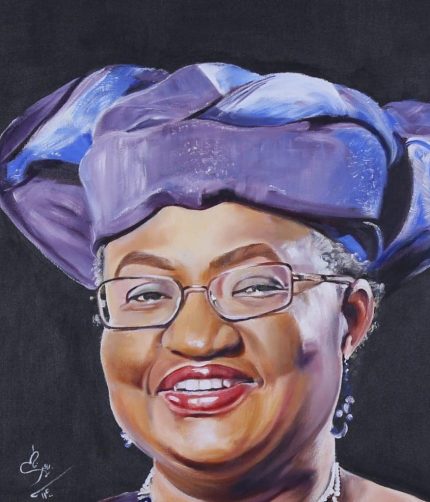
Dr Ngozi Okonjo-Iweala is the seventh Director-General of the WTO and the first woman and the first African to serve as Director-General.
Ngozi Okonjo-Iweala (born 13 June 1954) is a Nigerian-American economist, fair trade leader, environmental sustainability advocate, human welfare champion, sustainable finance maven and global development expert. Since March 2021, Okonjo-Iweala has been serving as Director-General of the World Trade Organization. Notably, she is the first woman and first African to lead the World Trade Organization as Director-General. She sits on boards of: Danone, Standard Chartered Bank, Twitter, MINDS: Mandela Institute for Development Studies, Carnegie Endowment for International Peace, Georgetown Institute for Women, Peace and Security, One Campaign, GAVI: Global Alliance for Vaccines and Immunization, Rockefeller Foundation, R4D: Results for Development, ARC: African Risk Capacity and Earthshot Prize plus others
Okonjo-Iweala was the first Nigerian woman to serve two terms as Finance Minister of Nigeria. Subsequently, from June to August 2006, she served as Minister for Foreign Affairs of Nigeria. In 2005, Euromoney named her Global Finance Minister of the Year.
1954 World Cup Painted Ball
Rated 0 out of 5
(0)
Highlights:
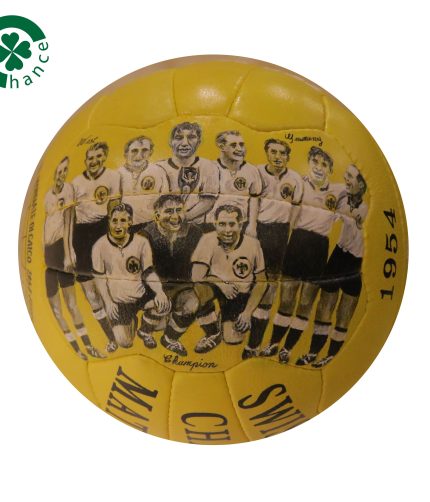
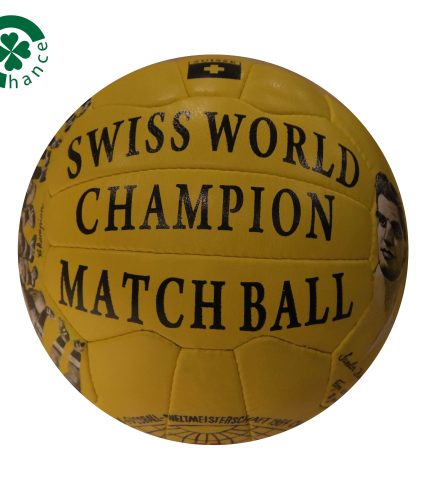
Product Name : 1954 World Cup Painted Ball
Date of Registration : 02/01/2023
Category Art : Painting
Art Field : Visual Arts
Total Production : One Collection with Twenty Three Balls
Production Year : 2022
Art Style : Acrylic
Ball Name : Swiss World Champion Match Ball
Artist Name : Fatemeh Zarei
Size : 5
Weight (gr) : 380 – 392
Has a signature : Yes
Materials :
The official match ball of the 1954 FIFA World Cup was composed of 18 panels with zigzag edges, perfectly interlocked to each other. (The same panel structure can be seen on many Mitre balls even today.) The ball was completely hand sewn and no longer had laces -just like its predecessor, the Superball from the 1950 World Cup. The colour of the ball was not dark brown any more, rather an attractive yellowish or hell orange. This made the ball more visible during rainy matches where the pitch contained mud. We can see lots of photographs in different newspapers and magazines from 1954 where the players are portrayed with the Swiss World Champion balls as this ball became by far the best selling World Cup ball compared to its predecessors.
About Swiss World Champion Match Ball :
this ball comes from the pre-adidas historical match ball set, it is the exact reproduction of the original Swiss World Champion balls as used at the 1954 World Cup in Switzerland.
Recently Viewed
1930 World Cup Painted Ball – Argentina Ball
Rated 0 out of 5
(0)
Highlights:
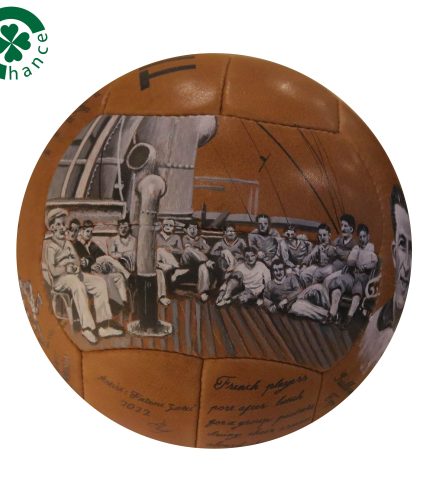
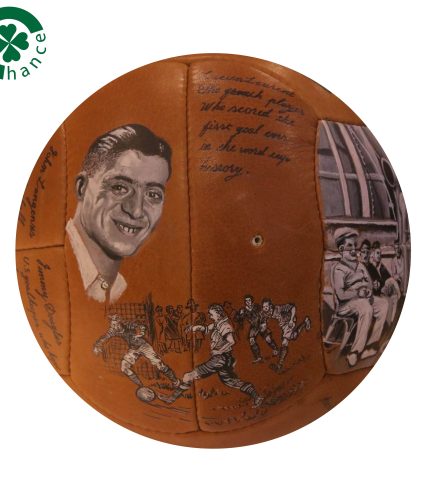
Product Name : 1930 World Cup Painted Ball – Argentina Ball
Date of Registration : 02/01/2023
Category Art : Painting
Art Field : Visual Arts
Total Production : One Collection with Twenty Three Balls
Production Year : 2022
Art Style : Acrylic
Ball Name : Tiento
Artist Name : Fatemeh Zarei
Size : 5
Weight (gr) : 380 – 410
Has a signature : Yes
Materials :
This vintage leather football ball with lace in made by John Woodbridge with 12 panels. A leather rigorously selected for its quality. Hand sewn, it is manufactured in the respect of the traditional techniques. Its hand-made patina gives it a unique style, a retro and elegant look that will delight collectors and old school sports objects lovers.
About Tiento :
two different balls were used in the final: Argentina supplied the first-half ball (the ‘Tiento’) and led 2–1 at the break; hosts Uruguay supplied the second-half ball (the ‘T-Model’ which was larger and heavier)[4] and won 4–2.
1930 World Cup Painted Ball – Uruguay Ball
Rated 0 out of 5
(0)
Highlights:
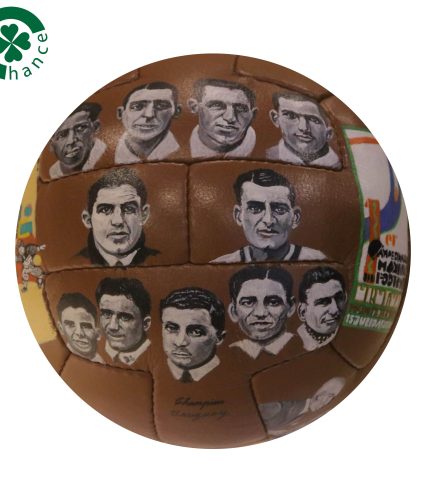
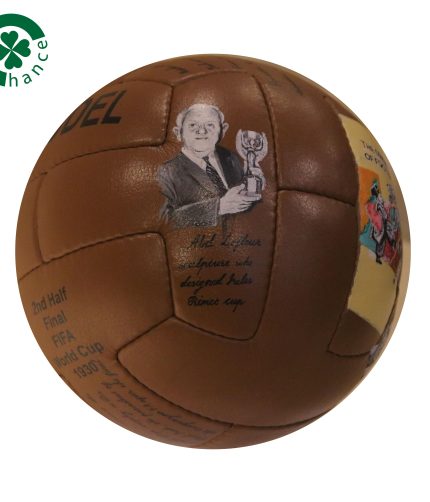
Product Name : 1930 World Cup Painted Ball – Uruguay Ball
Date of Registration : 02/01/2023
Category Art : Painting
Art Field : Visual Arts
Total Production : One Collection with Twenty Three Balls
Production Year : 2022
Art Style : Acrylic
Ball Name : T-Model
Artist Name : Fatemeh Zarei
Size : 5
Weight (gr) : 380 – 410
Has a signature : Yes
Materials :
Vintage leather football with 10 panels, this “T-shaped” ball is a replica of one of the most famous models of history. Handmade with Woodbridge “savoir-faire”, its patina give it an authentic old school and unique style.
An iconic model in football history, the “T-shape” is the ball that helped Uruguay win the inaugural edition of the World Cup. While the first half of the tournament final was played with the Argentinian favorite ball, Tiento, Celeste approached the second act with a goal behind, led 2 to 1. More comfortable with his An English-made T-shaped panel model, the host country team found the net three times to lift the Jules Rimet Trophy in front of the 70,000 spectators at the Centenario Stadium in Montevideo. On July 30, 1930 at 3.30 p.m., John Langenus, the Belgian referee of the match, entered the field with a ball under each arm in order not to favor either of the two nations. A unique event in the history of the round ball.
About T-Model :
Inspired by the famous “T-Shape” design used in the second half of the 1930 World Cup Final, with which the Uruguayan team won the very first edition of the most popular sports competition with a final score of 4-2 against Argentine, the John Woodbridge 1930 T-shape vintage football.
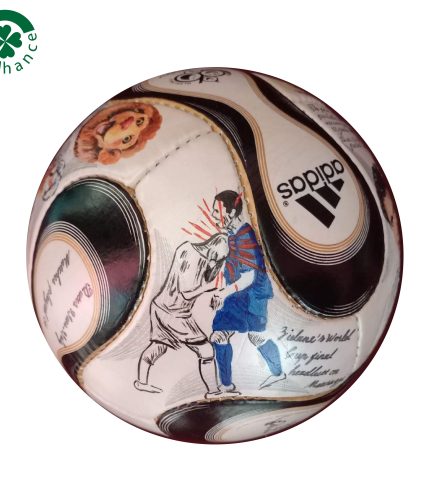
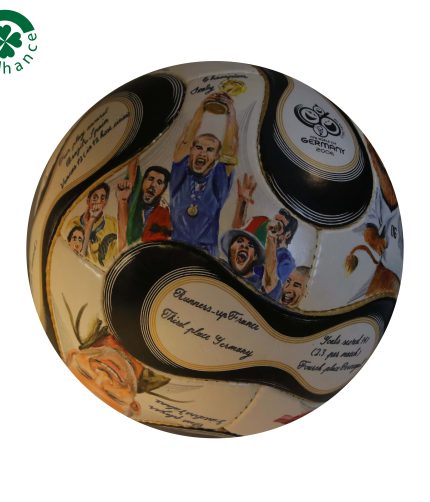
2006 World Cup Painted Ball
Rated 0 out of 5
(0)
Highlights:
Product Name : 2006 World Cup Painted Ball
Date of Registration : 02/01/2023
Category Art : Painting
Art Field : Visual Arts
Total Production : One Collection with Twenty Three Balls
Production Year : 2022
Art Style : Acrylic
Ball Name : Teamgeist
Artist Name : Fatemeh Zarei
Size : 5
Weight (gr) : 420 – 430
Has a signature : Yes
Materials :
The ball was designed by the Adidas Innovation Team and the Molten Corporation and is made by Adidas, which has provided the balls used in all World Cup matches since the 1970 World Cup when the Telstar was introduced. The +Teamgeist ball differs from previous balls in having just 14 curved panels (making the ball topologically equivalent to a truncated octahedron), rather than the 32 that have been standard since 1970. Like the 32 panel Roteiro which preceded it, the +TeamGeist panels are bonded together, rather than stitched. It is claimed to be rounder and to perform more uniformly regardless of where it is hit, and being almost waterproof, it does not get heavier in wet weather.
About Teamgeist :
With the name of “Teamgeist” the creators of the ball wanted to remind that one of the most important components of success in World Cup it’s “team spirit”. Translated from the German word team means “command” and geist – “spirit”.
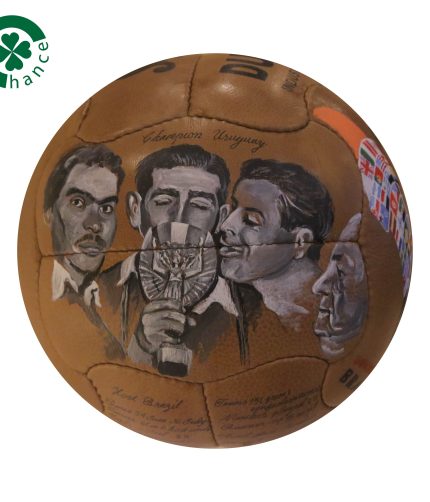
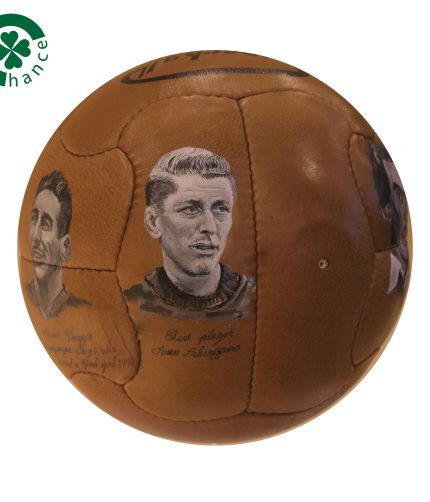
1950 World Cup Painted Ball
Rated 0 out of 5
(0)
Highlights:
Product Name : 1950 World Cup Painted Ball
Date of Registration : 02/01/2023
Category Art : Painting
Art Field : Visual Arts
Total Production : One Collection with Twenty Three Balls
Production Year : 2022
Art Style : Acrylic
Ball Name : Superball Duplo T
Artist Name : Fatemeh Zarei
Size : 5
Weight (gr) : 355 – 404
Has a signature : Yes
Materials :
Created in the early 1930s by the brazilian industrials Luis Pole, Antonio Tossolini and Juan Valbonesi, the “Superball Duplo T” is selected to be the official football of the 1950 “Copa do Mundo” in Brazil. Consisting of 12 leather panels and an air chamber with inflation valve, the Duplo T innovates technically compared to older models by not having a lace, which makes it rounder, avoids false rebounds and injuries to the players. Called “Duplo T” in reference to its famous double inverted T-design, this is a new evolution towards the modern football ball as we know it today.
About Superball Duplo T :
he 1950 John Woodbridge football is inspired by the design used during the 1950 Brazilian FIFA World Cup called “Duplo T” by Superball. This ball is handmade using traditional methods and is crafted from carefully chosen leather.
2010 World Cup Painted Ball
Rated 0 out of 5
(0)
Highlights:
Product Name : 2010 World Cup Painted Ball
Date of Registration : 02/01/2023
Category Art : Painting
Art Field : Visual Arts
Total Production : One Collection with Twenty Three Balls
Production Year : 2022
Art Style : Acrylic
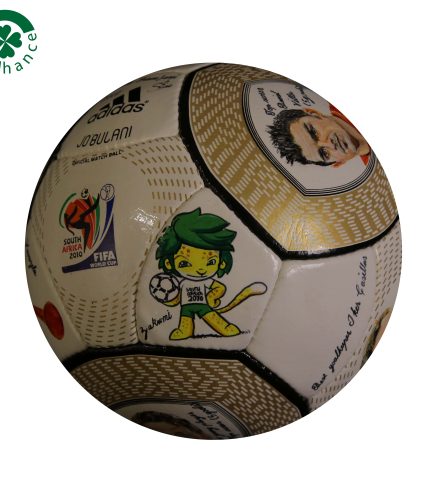
Ball Name : Jabulani
Artist Name : Fatemeh Zarei
Size : 5
Weight (gr) : 386 – 396
Has a signature : Yes
Materials :
The adidas Jabulani features 32 panels, each one representing a different African nation that will take part in this summer’s tournament. These nations are: Angola, Egypt, Ghana, Guinea, Ivory Coast, Kenya, Lesotho, Liberia, Madagascar, Malawi, Mozambique, Namibia, Nigeria, Rwanda, Senegal, Seychelles, Sierra Leone, Somalia, Sudan, Swaziland, Tanzania, Togo, Tunisia, Uganda, and Zimbabwe.
On top of having a beautiful design, the new Jabulani ball is technologically advanced, making it feel more like playing with a leather ball while providing consistent quality on all surfaces. It is also one of the most aerodynamic balls on the market today.
About Jabulani :
In language of the Zulu word Jabulani means “celebrate”. The World Cup 2010 ball is made in South African style. Jabulani comprises eight external structural panels interconnected by a heat seal technology, that increases Shot Accuracy.
1954 World Cup Painted Ball
Rated 0 out of 5
(0)
Highlights:
Product Name : 1954 World Cup Painted Ball
Date of Registration : 02/01/2023
Category Art : Painting
Art Field : Visual Arts
Total Production : One Collection with Twenty Three Balls
Production Year : 2022
Art Style : Acrylic
Ball Name : Swiss World Champion Match Ball
Artist Name : Fatemeh Zarei
Size : 5
Weight (gr) : 380 – 392
Has a signature : Yes
Materials :
The official match ball of the 1954 FIFA World Cup was composed of 18 panels with zigzag edges, perfectly interlocked to each other. (The same panel structure can be seen on many Mitre balls even today.) The ball was completely hand sewn and no longer had laces -just like its predecessor, the Superball from the 1950 World Cup. The colour of the ball was not dark brown any more, rather an attractive yellowish or hell orange. This made the ball more visible during rainy matches where the pitch contained mud. We can see lots of photographs in different newspapers and magazines from 1954 where the players are portrayed with the Swiss World Champion balls as this ball became by far the best selling World Cup ball compared to its predecessors.
About Swiss World Champion Match Ball :
this ball comes from the pre-adidas historical match ball set, it is the exact reproduction of the original Swiss World Champion balls as used at the 1954 World Cup in Switzerland.
1978 World Cup Painted Ball
Rated 0 out of 5
(0)
Highlights:
Product Name : 1978 World Cup Painted Ball
Date of Registration : 02/01/2023
Category Art : Painting
Art Field : Visual Arts
Total Production : One Collection with Twenty Three Balls
Production Year : 2022
Art Style : Acrylic
Ball Name : Tango Durlast
Artist Name : Fatemeh Zarei
Size : 5
Weight (gr) : 394 – 404
Has a signature : Yes
Materials :
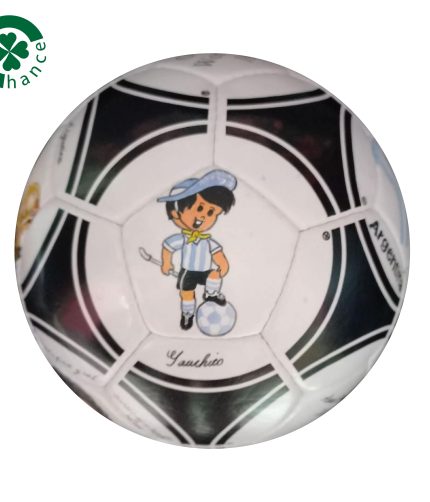
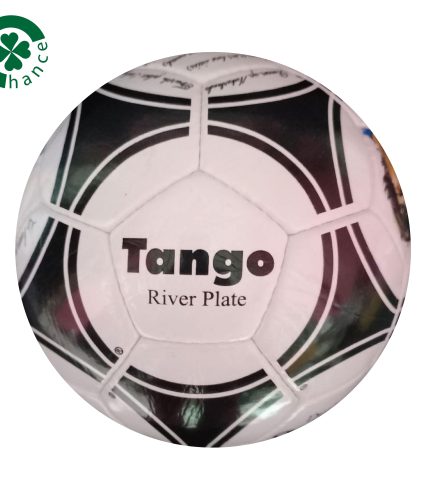
The 1978 World Cup came back to America, being hosted by Argentina. In respect of the official ball, this edition represented a great milestone, because Adidas launched a model with a revolutionary design: the Tango – inspired by the classic dance of Argentina. This ball was identically constructed to the previous World Cup ball, the Telstar from 1974. It was composed of 32 hand sewn leather panels (20 hexagonal and 12 pentagonal) and covered by the Durlast coating (applied with the same thickness of the 1974 Telstar) to
make the ball more resistant and waterproof. The design consisted of 20 black and promptly curved triangles, each one printed onto the white coloured surface of each hexagonal panel. Since the pentagonal panels were white coloured too, the triangles created a series of black and elegant circles on a white surface. When the ball was rotating, a nice effect was created by the black circles, which was visually very attractive.
About Tango Durlast:
For World Cup 1978 has been created ball Tango, which according to the authors should reflect the elegance, dynamism and passion. The design used 20 triads, create an optical impression of 12 identical circles. One advantage of Tango compared to other balls was considered as improved resistance to weathering.
Reviews
There are no reviews yet.