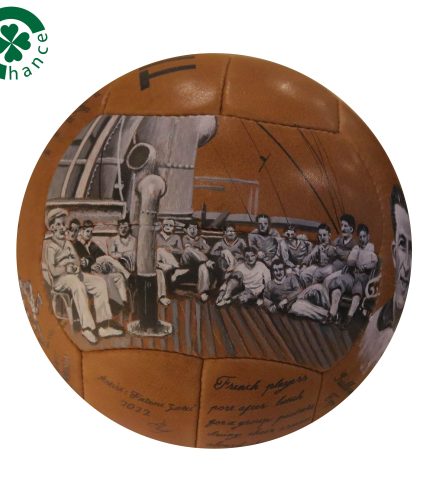
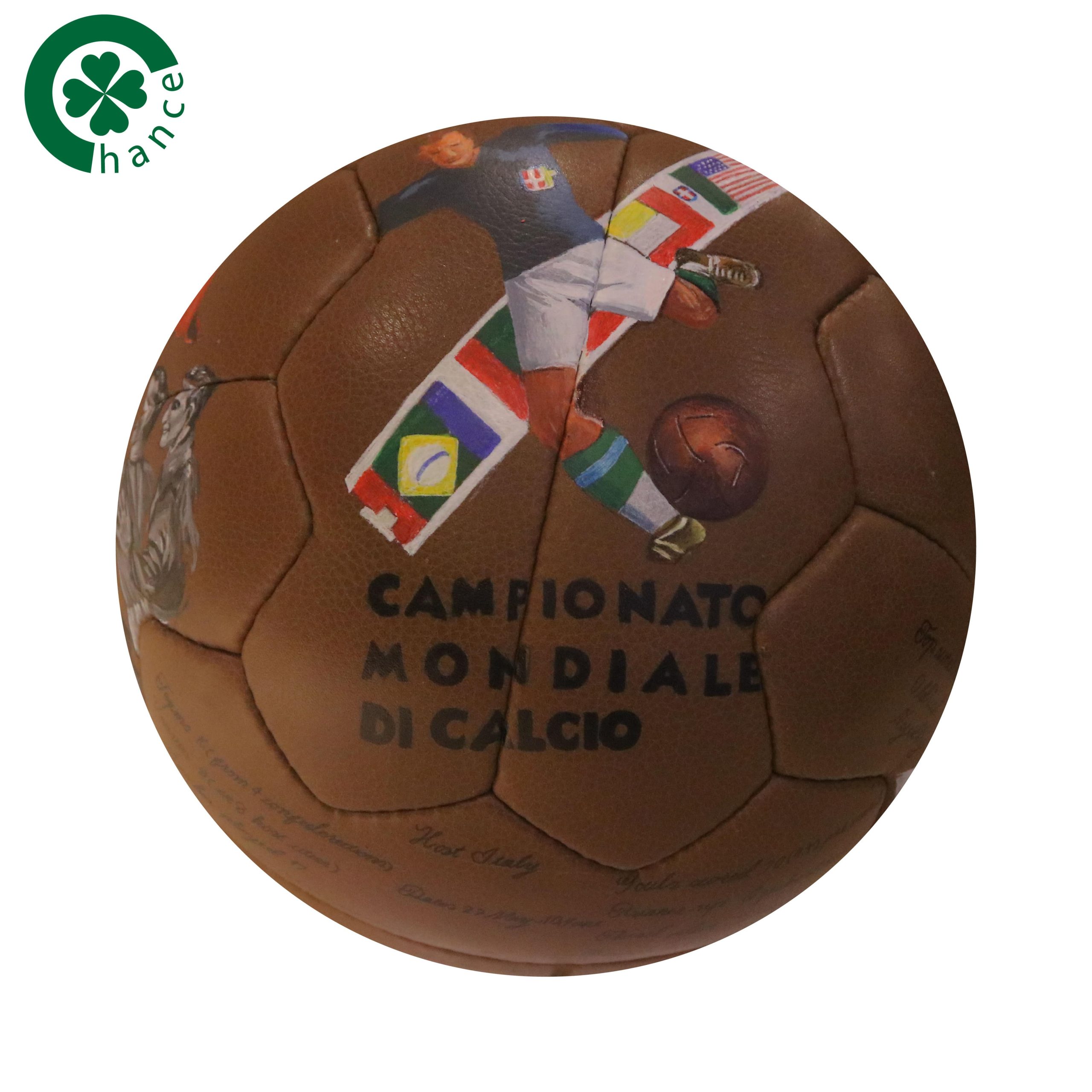
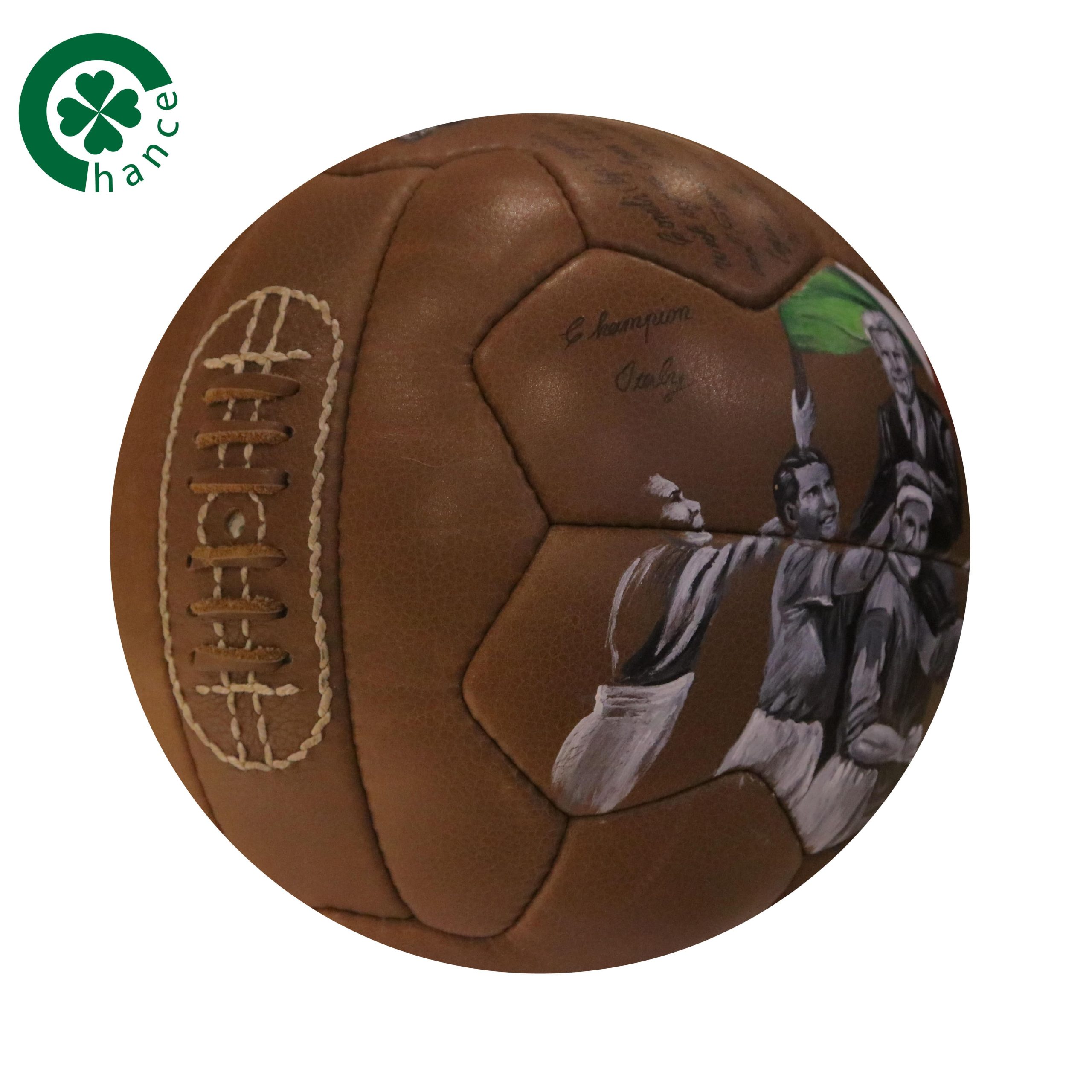
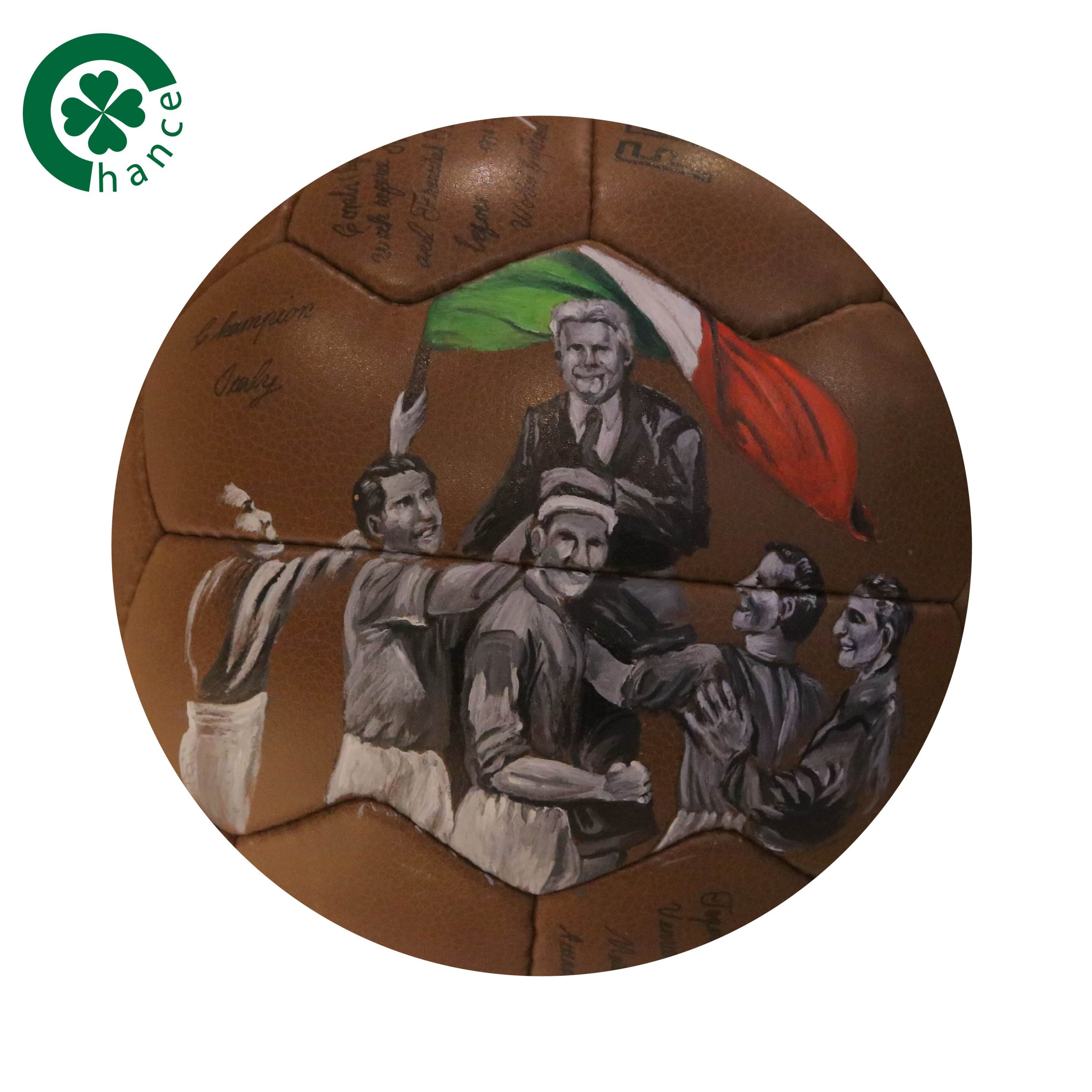
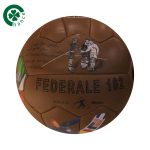
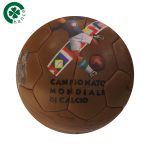
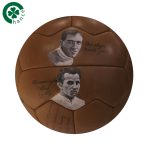
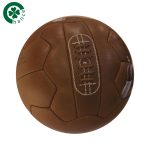
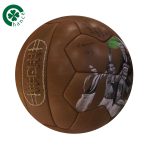
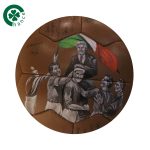
1934 World Cup Painted Ball
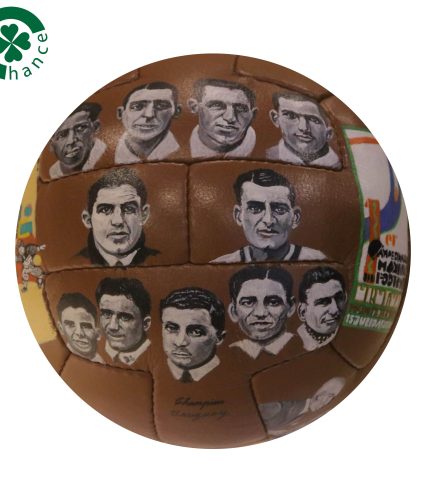
Product Name : 1934 World Cup Painted Ball
Date of Registration : 02/01/2023
Category Art : Painting
Art Field : Visual Arts
Total Production : One Collection with Twenty Three Balls
Production Year : 2022
Art Style : Acrylic
Ball Name : The Federale 102
Artist Name : Fatemeh Zarei
Size : 5
Weight (gr) : 380 – 420
Has a signature : Yes
Materials :
The Federale 102 ball was composed by 13 polygonal panels which were cut and perfectly fitted together by hand sewing. Most of the classic balls at that time were 12 panel models (like the ones used 4 years ago in the first World Cup) but the Federale 102 brought an invention of having the laces on a separate panel to inflate the balls. The bladder was enclosed by lace with 6 rows. For the very first time the leather laces of a World Cup ball were replaced by brown cotton,very similar to the ones used on shoes. This represents a small detail but an important improvement, as well. As cotton is much softer than any leather,this encouraged players to head the ball more.
About The Federale 102 :
As the second World Cup was approaching,the fascist regime of Mussolini became so powerful that Italy was chosen to be the host of the 1934 FIFA World Cup.The strong nationalism requested that the balls used in the tournament had to be produced in Italy. In the beginning of the 20th century the majority of footballs were made in Britain and were exported to different countr ies where footba ll became more and more popular and equipment was badly needed. But as previously mentioned, the Italian political power insisted on using Italian made balls for the first World Cup to be hosted in Europe.
Related products
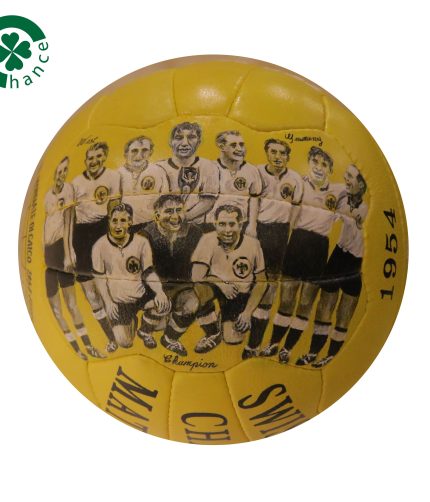
1954 World Cup Painted Ball
Product Name : 1954 World Cup Painted Ball
Date of Registration : 02/01/2023
Category Art : Painting
Art Field : Visual Arts
Total Production : One Collection with Twenty Three Balls
Production Year : 2022
Art Style : Acrylic
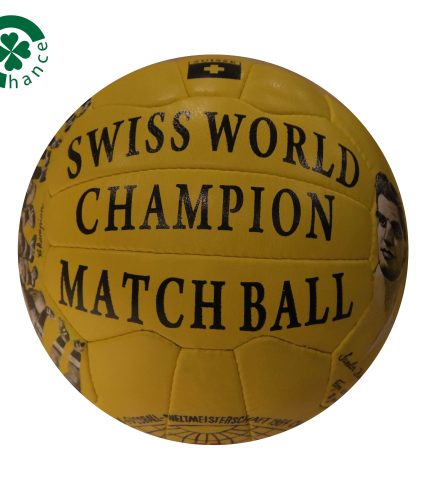
Ball Name : Swiss World Champion Match Ball
Artist Name : Fatemeh Zarei
Size : 5
Weight (gr) : 380 – 392
Has a signature : Yes
Materials :
The official match ball of the 1954 FIFA World Cup was composed of 18 panels with zigzag edges, perfectly interlocked to each other. (The same panel structure can be seen on many Mitre balls even today.) The ball was completely hand sewn and no longer had laces -just like its predecessor, the Superball from the 1950 World Cup. The colour of the ball was not dark brown any more, rather an attractive yellowish or hell orange. This made the ball more visible during rainy matches where the pitch contained mud. We can see lots of photographs in different newspapers and magazines from 1954 where the players are portrayed with the Swiss World Champion balls as this ball became by far the best selling World Cup ball compared to its predecessors.
About Swiss World Champion Match Ball :
this ball comes from the pre-adidas historical match ball set, it is the exact reproduction of the original Swiss World Champion balls as used at the 1954 World Cup in Switzerland.
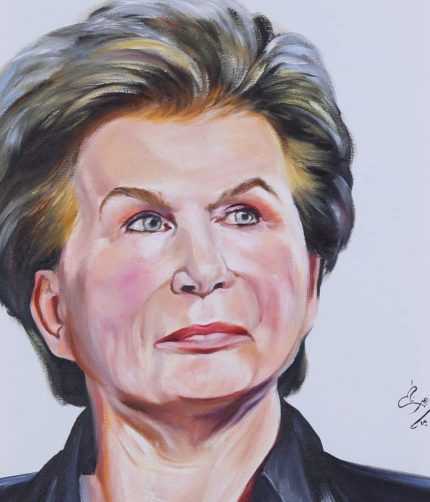
Valentina Tereshkova
he first woman cosmonaut in the world
The history of humans in space dates back to 1961, and the first women stepped into space in 1963
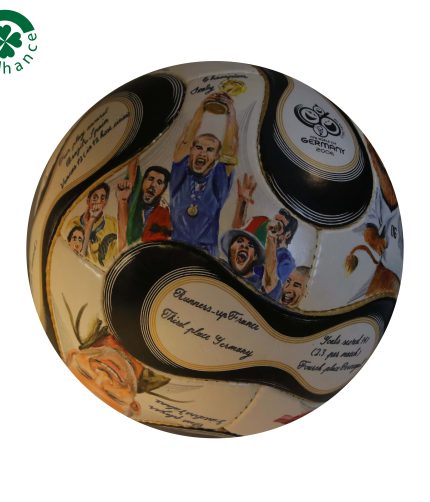
2006 World Cup Painted Ball
Product Name : 2006 World Cup Painted Ball
Date of Registration : 02/01/2023
Category Art : Painting
Art Field : Visual Arts
Total Production : One Collection with Twenty Three Balls
Production Year : 2022
Art Style : Acrylic
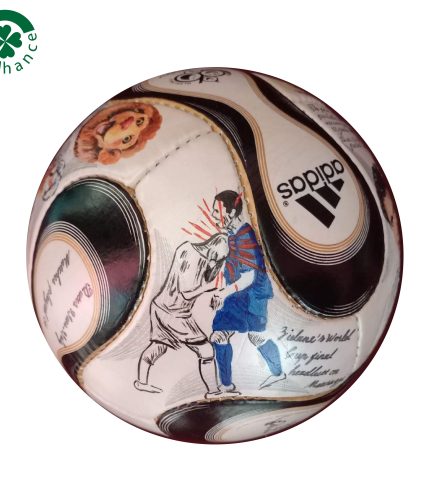
Ball Name : Teamgeist
Artist Name : Fatemeh Zarei
Size : 5
Weight (gr) : 420 – 430
Has a signature : Yes
Materials :
The ball was designed by the Adidas Innovation Team and the Molten Corporation and is made by Adidas, which has provided the balls used in all World Cup matches since the 1970 World Cup when the Telstar was introduced. The +Teamgeist ball differs from previous balls in having just 14 curved panels (making the ball topologically equivalent to a truncated octahedron), rather than the 32 that have been standard since 1970. Like the 32 panel Roteiro which preceded it, the +TeamGeist panels are bonded together, rather than stitched. It is claimed to be rounder and to perform more uniformly regardless of where it is hit, and being almost waterproof, it does not get heavier in wet weather.
About Teamgeist :
With the name of “Teamgeist” the creators of the ball wanted to remind that one of the most important components of success in World Cup it’s “team spirit”. Translated from the German word team means “command” and geist – “spirit”.
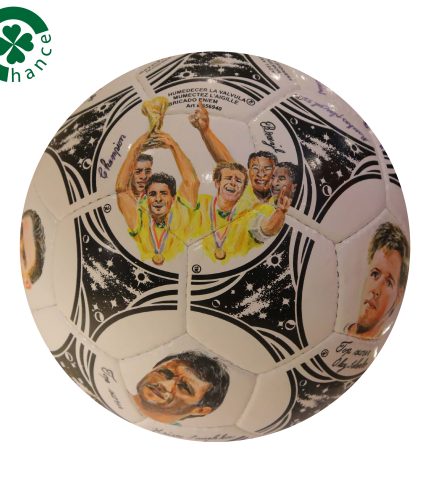
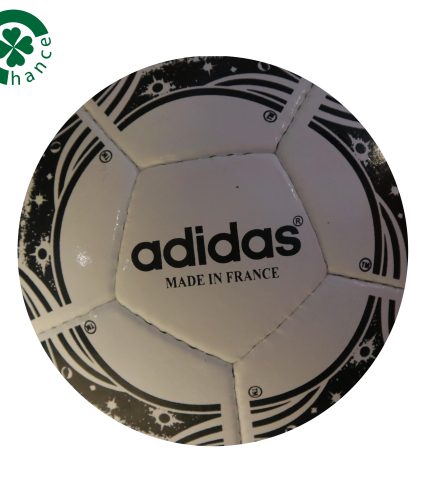
1994 World Cup Painted Ball
Product Name : 1994 World Cup Painted Ball
Date of Registration : 02/01/2023
Category Art : Painting
Art Field : Visual Arts
Total Production : One Collection with Twenty Three Balls
Production Year : 2022
Art Style : Acrylic
Ball Name : Questra
Artist Name : Fatemeh Zarei
Size : 5
Weight (gr) : 388 – 398
Has a signature : Yes
Materials :
At the 1990 World Cup in Italy, a negative World Cup record was set in terms of goals (2.21 goals/match), so many blamed the ball Before the next World Cup, FIFA asked adidas to develop a ball that could score more goals. The 1994 World Cup was brought to the USA in part to promote soccer, but if viewers don’t see enough goals, they tune out of the games on TV and think soccer is a boring
sport. The changes to the ball were successful, as the American World Cup had a higher goal average (2.7 goals/match), which they have not been able to surpass in any World Cup since then.
And what were the changes on the ball? Well, the Questra was lighter and more controllable than its predecessor, which favored more skilled players. Five different materials were used during development, and its most significant innovation was the flexible but resistant outer polyurethane layer, which softened the force of impacts thanks to foaming, and it was also beneficial for the headers.
This is due to the fact that the ball was developed at adidas’ ball production center in France and tested by French, German and American professional, amateur and youth teams.
About Questra :
Name of the Questra ball comes from ancient world for the pursuit to the stars (the quest for the stars). Authors aimed to create a more responsive and light ball, what they got fully. By manufacturing the new ball from five different materials and enveloping it in polystyrene foam, Adidas made the Questra more waterproof and allowed for greater acceleration when kicked. Triads which used in the design of Adidas Questra, display the outlines of stars.
Anna Wintour
Queen of the fashion world
Dame Anna Wintour DBE (born 3 November 1949) is a British-American journalist, who has served as Editor-in-Chief of Vogue since 1988 and Global Chief Content Officer for Condé Nast since 2020;
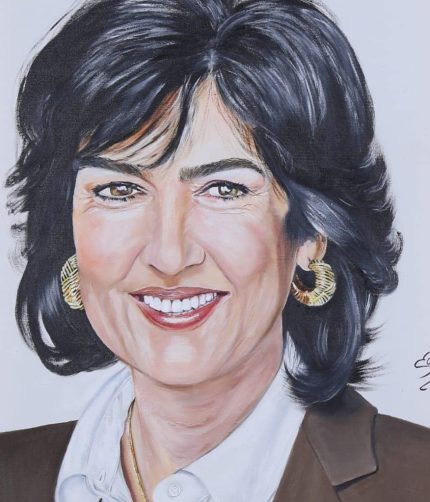
Christian Amanpour
Christiane Amanpour
Amanpour is a British-Iranian reporter and TV host. She is the Chief International Anchor for CNN and host of CNN International’s nightly interview show Amanpour. She also runs the Amanpour & Company programs on PBS. She was previously the host of the global affair for ABC News in the United States. She is one of the journalists who is most followed by world leaders on Twitter. Amanpour has an Iranian father and a British mother.
Nansy Pelosi
the first Californian, the first Italian-American and the first woman to become Speaker of the US House of Representatives
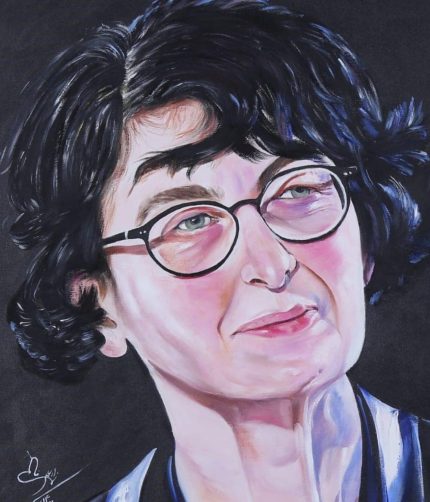
Ozlem Tourechi
German_Turkish scientist, Immunologist entrepreneur, co-founder of German biotechnology company BioNTech, Chief Medical Officer of BioNTech. Pfizer_BioNTech COVID-19 vaccine creator
2002 World Cup Painted Ball
Product Name : 2002 World Cup Painted Ball
Date of Registration : 02/01/2023
Category Art : Painting
Art Field : Visual Arts
Total Production : One Collection with Twenty Three Balls
Production Year : 2022
Art Style : Acrylic
Ball Name : Fevernova
Artist Name : Fatemeh Zarei
Size : 5
Weight (gr) : 389 – 398
Has a signature : Yes
Materials :
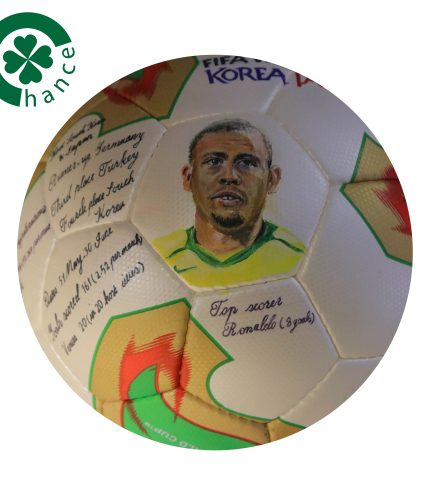
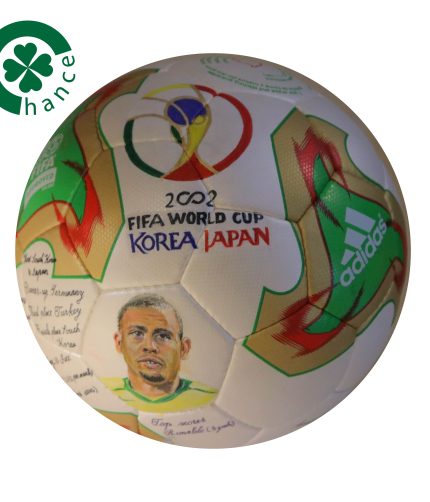
Adidas’s Fevernova soccer ball was the official ball of the Korea Japan, 2002 FIFA world cup. The adidas Fevernova was the first World Cup Match Ball since 1978 to break with the traditional Tango design introduced in 1978. It is three millimeters thick (11 layers). This includes a special foam layer with tiny gas filled balloons imbedded in a syntactic foam. The foam is based on an abrasion resistant polyurethane made by Bayer called Impranil® polyurethane. The outer cover of the ball consists of a combination of special synthetic polystyrenes (polyurethane) and natural rubber. Embedded within the layers are equal sized, highly elastic, exceptionally resistant gas-filled microcells. The inner lining consists of a tightly woven network of knitted, synthetic Raschel fabric. The spongy layer has high modulus of compression, with a good elastic memory. These layers give the Fevernova TM improved rebound characteristics, which convert foot strike into ball acceleration. The outer layer of the ball is made of a particularly so that the ball can withstand exceptionally tough treatment. All of this combines to give the ball greater durability. According to Adidas, the surface of the new ball converts applied energy evenly at every point. Theoretically, this gives a more calculable, flight path with advanced players. The Adidas Fevernova TM is made to meet the lower end of FIFA regulations governing circumference and the upper limit of weight , in which smaller and heavier sphere has a more accurate trajectory.
About Fevernova :
The ball Fevernova has been obtained as a result of three years of work to improve the previous Tricolore ball at the research center in south of Germany.
The new design is based on Asian culture and are not similar to its predecessors. This ball featured a refined syntactic foam layer, to give the ball superior performance characteristics, and a three-layer knitted chassis, allowing for a more precise and predictable flight path. For the World Cup matches has been presented more than 2,500 balls Fevernova, and later around the world has been sold about six million replicas.
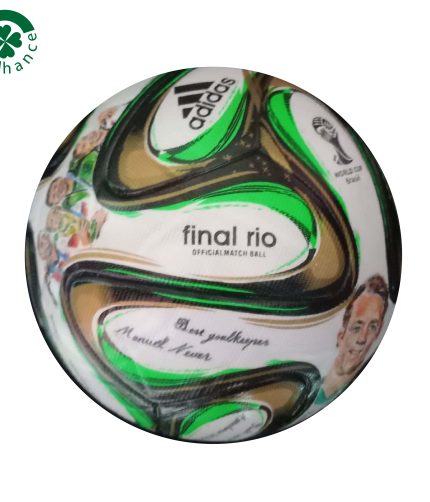
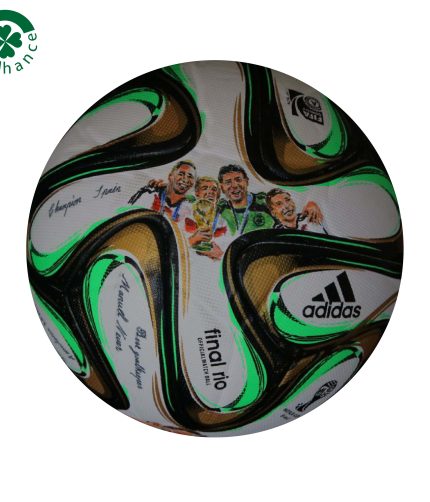
2014 World Cup Painted Ball
Product Name : 2014 World Cup Painted Ball
Date of Registration : 02/01/2023
Category Art : Painting
Art Field : Visual Arts
Total Production : One Collection with Twenty Three Balls
Production Year : 2022
Art Style : Acrylic
Ball Name : Brazuca
Artist Name : Fatemeh Zarei
Size : 5
Weight (gr) : 425 – 432
Has a signature : Yes
Materials :
The Brazuca official match ball has only 6 flat parts, 12 seams and 8 joint points – but the seams do not go along the edges of the cube they go over a complex curve. This provide suitable aerodynamics and an unrivaled circular shape to the ball.
The Brazuca 2014 ball decorated with ribbons of three colors, which symbolizing the so-called bracelets desires in Brazil. According to legend, the bangle should be wrapped around the wrist and tie the knot three with making a wish on each of them. When the bracelet will tear himself fall from his hands, they believed that it’s made wishes should start to come true.
About Brazuca :
The name of the 2014 World Cup ball has been selected in an open vote, which was attended by more than 1 million of Brazilians. Has been proposed 3 names: Brazuca (77.5%), Carnavalesca (14.6%) and Bossa Nova (7.6%).
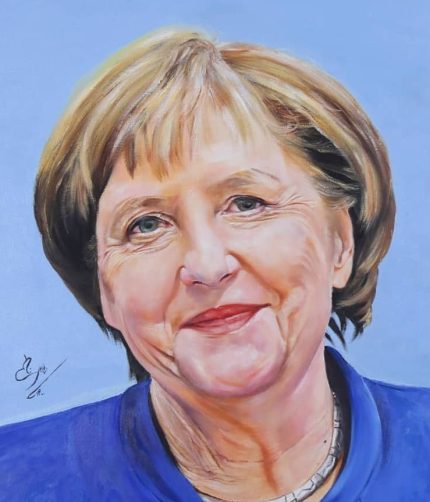
Angela Merkel
Angela Merkel Chancellor of Germany
The Most Influential Political woman in art
Recently Viewed
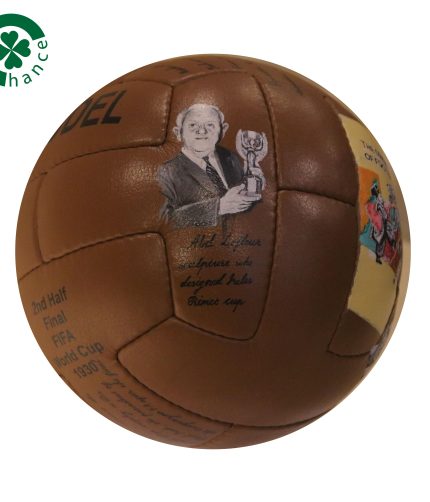
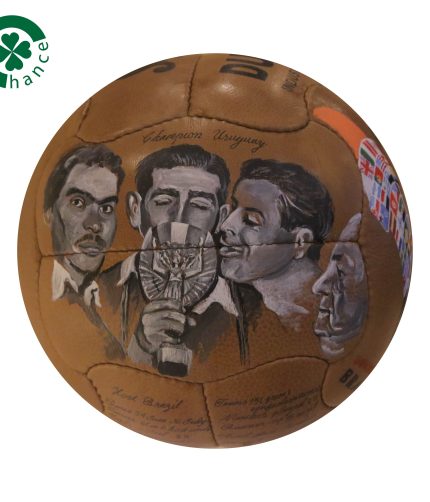
1930 World Cup Painted Ball – Uruguay Ball
Product Name : 1930 World Cup Painted Ball – Uruguay Ball
Date of Registration : 02/01/2023
Category Art : Painting
Art Field : Visual Arts
Total Production : One Collection with Twenty Three Balls
Production Year : 2022
Art Style : Acrylic
Ball Name : T-Model
Artist Name : Fatemeh Zarei
Size : 5
Weight (gr) : 380 – 410
Has a signature : Yes
Materials :
Vintage leather football with 10 panels, this “T-shaped” ball is a replica of one of the most famous models of history. Handmade with Woodbridge “savoir-faire”, its patina give it an authentic old school and unique style.
An iconic model in football history, the “T-shape” is the ball that helped Uruguay win the inaugural edition of the World Cup. While the first half of the tournament final was played with the Argentinian favorite ball, Tiento, Celeste approached the second act with a goal behind, led 2 to 1. More comfortable with his An English-made T-shaped panel model, the host country team found the net three times to lift the Jules Rimet Trophy in front of the 70,000 spectators at the Centenario Stadium in Montevideo. On July 30, 1930 at 3.30 p.m., John Langenus, the Belgian referee of the match, entered the field with a ball under each arm in order not to favor either of the two nations. A unique event in the history of the round ball.
About T-Model :
Inspired by the famous “T-Shape” design used in the second half of the 1930 World Cup Final, with which the Uruguayan team won the very first edition of the most popular sports competition with a final score of 4-2 against Argentine, the John Woodbridge 1930 T-shape vintage football.


Reviews
There are no reviews yet.